Friday, August 19, 2016

Rosa rugosa


Rosa rugosa 'Hansa'

Rosa rugosa is one of the easiest, most drought tolerant, disease resistant & low-maintenance roses you can grow in Seattle.  It bears attractive flowers, foliage & fruits.  The fruits are large & resemble tomatoes.  Rosa rugosa doesn't often need pruning.  The canes grow to a height of about 3 to 4 feet covered in numerous spines, not the thorns typical of many roses.  Wear gloves when pruning.  The highly fragrant flowers may be single or double in the standard rose colors of red, pink, white & yellow.  Rosa rugosa 'Blanc Double de Coubert' is a popular white rose.  Rosa rugosa has many common names including sea tomato & beach rose.  The name I hear most frequently is rugosa rose.  Rugosa means wrinkled, or rugose.   Rosa rugosa is native to eastern Asia in China, Japan & Korea along the coast, often on sand dunes.  It is considered an invasive species along the coasts of northern Europe & New England.  But this shouldn't be a concern in an urban garden setting.  As with all roses, grow this plant in full sun, in well drained soil.  It blooms in July & August.

Friday, August 5, 2016

Japantown in San Francisco


Japantown in San Francisco in April 2014

Japantown is a fascinating piece of urban landscape for those interested in both the cultural history of San Francisco & the history of architecture.  Here is an example that is uncommon in North America: mid-century modern Japanese commercial architecture & public landscape design.  I've never seen anything else quite like it.  It could be the set for a Japanese film made in 1968, the year Japantown opened.  The modern design of the pagoda is bold & intricate, while the fountains are minimal, yet accommodating in their seating.  In addition to the short streetscape pictured here, there is a mall.  Both are filled with shops & restaurants.  A few other, taller mid-century buildings provide some backdrop.  Japantown is near the Fillmore Street business district in Pacific Heights, also filled with shops & restaurants.

Tuesday, July 19, 2016

Acanthus hungaricus


Acanthus hungaricus

Acanthus hungaricus is a fairly common species of Acanthus in Seattle.  It is more tolerant of dryness than Acanthus mollis, which is much more common.  Acanthus hungaricus has beautiful, holly-like foliage that is not at all spiny.  Flowers come in midsummer, with purple bracts forming hoods over white corollas, which line the stems in many tiers to present quite an impressive display of flowers.  The stems may reach 4 feet in height, but more usually 3 feet.  This plant spreads continually, but not very aggressively & will need to be divided when it begins to crowd its neighbors.  Acanthus hungaricus is a perennial plant for full sun in well drained soil.  It is native to Europe in Romania, the Balkans & Greece.  The common name for Acanthus is bear's breeches, in this case Hungarian bear's breeches.  I hear it called Acanthus more often.

Friday, July 1, 2016

Butchart Gardens


Cafeteria & gift shop complex near the entrance


3 photos above of the sunken garden, the main part of Butchart Gardens

The rose garden.  All photos were taken in August 2014.

Butchart Gardens is the principal tourist attraction on Vancouver Island near the city of Victoria, the provincial capital of British Columbia.  It receives over 1 million visitors a year. It is the tackiest garden I have ever seen. The fact that it is a huge garden makes it all the more difficult to bear. In August, it was very crowded with tourists. And to top it off, it cost more than $30 per person to enter.  I suspected I might not like it, but felt I must see it at least once. I had been to Victoria at least 5 times before & never gone. It was mostly filled with annual bedding plants in the style that was popular in the early 20th century. These same plants are used over & over again in different combinations. It looks best from above & at a distance.  The main part of the garden was created between 1909 & 1921 in an old limestone quarry. Other gardens were added later. There is a reasonably interesting Japanese garden, as well as less interesting Italian & rose gardens. The Italian garden displays the same endlessly repeated bedding plants in a formal design.

Friday, June 17, 2016

Euphorbia nicaeensis


Euphorbia nicaeensis


Euphorbia nicaeensis with Stachys byzantina (Lamb's Ears)

Euphorbia nicaeensis is a perennial plant, evergreen in Seattle, with new stems in spring reaching two feet in length & replacing the stems of the previous year, which wither during the summer, as in many other Euphorbia species.  It blooms in June.  The plant is easy to grow, requires very little water & good drainage.  It is a good candidate for a Mediterranean garden & really quite lovely.  Euphorbia nicaeensis is similar in size & shape to Euphorbia rigida, another worthwhile & more common species.  Euphorbia nicaeensis is a bit difficult to find.  I ordered mine from Joy Creek Nursery in Scappoose, Oregon. Euphorbia nicaeensis is native to Europe in Portugal, Spain, France, Italy & Croatia, as well as Turkey & the Caucasus.  Nicaea was an ancient city which now lies within the modern Turkish city of Iznik.  Nicaea Maritima was the ancient Roman name for the city of Nice, France.  The specific epithet 'nicaeensis' (of Nicaea) can refer to either city, both within the range of this plant.  It was likely observed by the participants of the Council of Nicaea in the year 325, which may be significant to those interested in early Christian history.

Friday, June 3, 2016

Prairie Creek Redwoods State Park

Sequoia sempervirens (Coast Redwood)


Prairie Creek

Cathedral Trees Trail 

Little Creek Trail

Oxalis oregana (Redwood Sorrel)

Disporum hookeri (Hooker's Fairy Bells) Photos taken in April 2014

You can find Prairie Creek Redwoods State Park in northern California between Crescent City & Eureka.  It exists in a very green & beautiful part of the world with beaches, redwood forest & meadows grazed by Roosevelt elk. You can stay at either Elk Prairie or Gold Bluffs Beach campgrounds.  But I think most people drive through this park along Newton Drury Scenic Parkway, perhaps stopping to walk some of the 75 miles of hiking trails. We walked on the Little Creek Trail from the north end of the trail to Elk Prairie, where we saw elk at a distance.  Then we walked back to the car along the Rhododendron Trail, which was not as lovely.  We saw many huge redwood trees along both trails, as well as forest plants that grow near the Pacific coast from northern California into British Columbia.  The redwoods themselves barely extend north across the Oregon border.  Prairie Creek Redwoods State Park is managed cooperatively by the National Park Service & the California Department of Parks and Recreation, along with Del Norte Coast Redwoods State Park, Jedediah Smith Redwoods State Park & Redwood National Park.

Friday, May 20, 2016

Allium karataviense


Allium karataviense is a bulb with a flower about the size of a baseball.  The usual color of the flower is a very pale pink.  Allium karataviense 'Ivory Queen' has white flowers.  There is also an uncommon form named 'Red Globe'.  Allium karataviense blooms in May, earlier than most Allium, which generally bloom in June.  The plant is not very tall, maybe 6 to 8 inches.  Each bulb produces one flower & just a few blue-green leaves.  Allium karataviense spreads slowly by the division of the bulbs & also by seed.  It takes some years for the seedlings to flower, but one flower can produce many seedlings.  A large group of flowers may arise in dry & sunny locations with good drainage in winter.  There is no need for summer water.  Allium karataviense grows naturally in the dry mountains of Central Asia.  It is sometimes called the Turkestan onion.  I think this is one of the more beautiful Allium, both in leaf & in flower.  Rainwater is often cupped at the base of the leaf pairs like sparkling jewels.

Friday, May 6, 2016

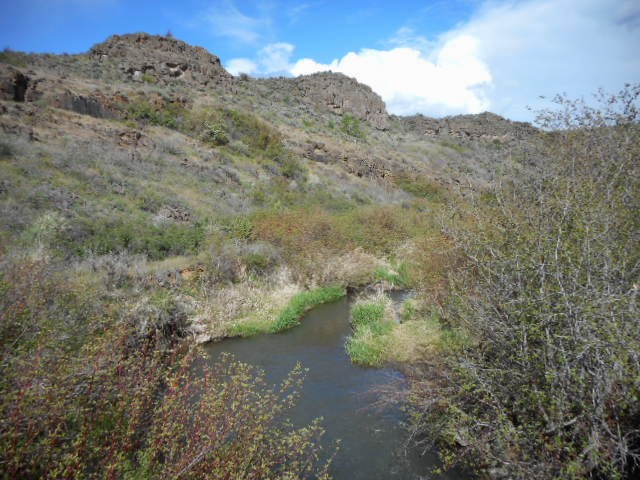
Cowiche Canyon


Cowiche Creek


Cowiche Canyon in April 2015

Click here for more photos of Cowiche Canyon.

Cowiche Canyon is located in Yakima WA.  It is quite a stunning & an easy walk.  Even though the surrounding area is heavily developed in housing & orchards, it looks perfectly natural.  The canyon encloses the view to conceal everything but the native plants, the landscape & the wide, level path with 9 sturdy bridges over Cowiche Creek.  (In case you wonder, Cowiche is pronounced: cow-itchy.)  This trail was once a railroad bed.  It runs slightly more than 3 miles long & connects to 4 other trails.  The Cowiche Canyon Conservancy is the owner & caretaker of the trail. It's mission is to preserve & restore shrub-steppe & riparian terrain within the Cowiche Creek & Naches River watershed areas in the Yakima Valley. It own 2,000 acres & has a conservation easement on another 3,000 acres of land.

Monday, April 18, 2016

Dicentra formosa

Dicentra formosa (Native Bleeding Heart)

Dicentra formosa is a perennial forest plant native to the Northwest Coast, from the Pacific Ocean to the Cascade Mountains in Washington & Oregon.  It is one of our most beautiful native plants.  The flowers are usually a pale pink, but darker individuals, like the one shown in this photo, can be found. In time, one plant will spread widely by its creeping rootstock & also by seed.  Over several years it may fill up a shaded area.  Dicentra formosa does not grow well in full sun, but will take some partly sunny locations.  This is primarily a plant of the forest floor with moderate water needs in summer.  The leaves have a pleasing, fern-like appearance.  They die to the ground in winter.  Dicentra formosa pairs nicely with Oxalis oregana, a native forest groundcover.  Find them in the native plant section of most nurseries in the Seattle area.

Friday, April 1, 2016

National AIDS Memorial Grove


National AIDS Memorial Grove in Golden Gate Park, San Francisco in April 2014

The National AIDS Memorial Grove is located in the de Laveaga dell in Golden Gate Park in San Francisco. The dell has always been one of the most charming parts of the park, which has nowhere near the topography as most of this city, notorious for its steep hills. The park is gently rolling & the dell makes a small cleft at its eastern end, not far from the residential & business district of the Haight. The dell contained redwood trees long before the creation of the AIDS grove, which added more of the trees & greatly improved the landscaping of the entire length of the dell. It is a pleasure to spend time in this quiet little forest. The small plaza is inscribed with the names of people who have died from AIDS. There is a curved bench along a low stone wall.  The landscape here is tasteful in every way.

The de Laveaga dell was created through a gift from the estate of Jose Vicente de Laveaga in 1898. When the dell was opened to in 1921, it included a lake & stream, with live oaks & tree ferns that still exist at the opposite end from the redwood grove.  The lake has become a lawn & the stream is mostly dry stones.  The present form of this landscape began in 1991 with the first work party of volunteers.  In that same year, a team of landscape professionals, under the guidance of Garrett Eckbo, developed the basic design & master plan, approved the following year.  The US Congress & President Bill Clinton approved the National AIDS Memorial Grove Act in 1996, which officially set aside the dell as the site for the first AIDS memorial in the nation. This legislation was introduced by Representative Nancy Pelosi & Senator Dianne Feinstein, both from the San Francisco Bay Area. Feinstein is a former mayor of San Francisco.