Friday, June 3, 2016

Prairie Creek Redwoods State Park

Sequoia sempervirens (Coast Redwood)


Prairie Creek

Cathedral Trees Trail 

Little Creek Trail

Oxalis oregana (Redwood Sorrel)

Disporum hookeri (Hooker's Fairy Bells) Photos taken in April 2014

You can find Prairie Creek Redwoods State Park in northern California between Crescent City & Eureka.  It exists in a very green & beautiful part of the world with beaches, redwood forest & meadows grazed by Roosevelt elk. You can stay at either Elk Prairie or Gold Bluffs Beach campgrounds.  But I think most people drive through this park along Newton Drury Scenic Parkway, perhaps stopping to walk some of the 75 miles of hiking trails. We walked on the Little Creek Trail from the north end of the trail to Elk Prairie, where we saw elk at a distance.  Then we walked back to the car along the Rhododendron Trail, which was not as lovely.  We saw many huge redwood trees along both trails, as well as forest plants that grow near the Pacific coast from northern California into British Columbia.  The redwoods themselves barely extend north across the Oregon border.  Prairie Creek Redwoods State Park is managed cooperatively by the National Park Service & the California Department of Parks and Recreation, along with Del Norte Coast Redwoods State Park, Jedediah Smith Redwoods State Park & Redwood National Park.

Friday, May 20, 2016

Allium karataviense


Allium karataviense is a bulb with a flower about the size of a baseball.  The usual color of the flower is a very pale pink.  Allium karataviense 'Ivory Queen' has white flowers.  There is also an uncommon form named 'Red Globe'.  Allium karataviense blooms in May, earlier than most Allium, which generally bloom in June.  The plant is not very tall, maybe 6 to 8 inches.  Each bulb produces one flower & just a few blue-green leaves.  Allium karataviense spreads slowly by the division of the bulbs & also by seed.  It takes some years for the seedlings to flower, but one flower can produce many seedlings.  A large group of flowers may arise in dry & sunny locations with good drainage in winter.  There is no need for summer water.  Allium karataviense grows naturally in the dry mountains of Central Asia.  It is sometimes called the Turkestan onion.  I think this is one of the more beautiful Allium, both in leaf & in flower.  Rainwater is often cupped at the base of the leaf pairs like sparkling jewels.

Friday, May 6, 2016

Cowiche Canyon


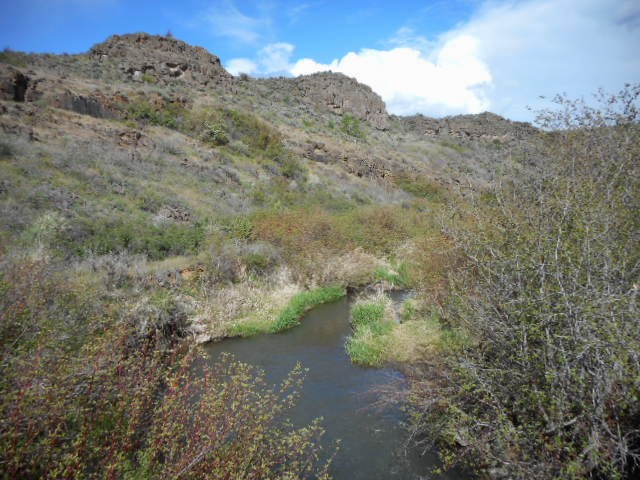
Cowiche Creek


Cowiche Canyon in April 2015

Click here for more photos of Cowiche Canyon.

Cowiche Canyon is located in Yakima WA.  It is quite a stunning & an easy walk.  Even though the surrounding area is heavily developed in housing & orchards, it looks perfectly natural.  The canyon encloses the view to conceal everything but the native plants, the landscape & the wide, level path with 9 sturdy bridges over Cowiche Creek.  (In case you wonder, Cowiche is pronounced: cow-itchy.)  This trail was once a railroad bed.  It runs slightly more than 3 miles long & connects to 4 other trails.  The Cowiche Canyon Conservancy is the owner & caretaker of the trail. It's mission is to preserve & restore shrub-steppe & riparian terrain within the Cowiche Creek & Naches River watershed areas in the Yakima Valley. It own 2,000 acres & has a conservation easement on another 3,000 acres of land.

Monday, April 18, 2016

Dicentra formosa

Dicentra formosa (Native Bleeding Heart)

Dicentra formosa is a perennial forest plant native to the Northwest Coast, from the Pacific Ocean to the Cascade Mountains in Washington & Oregon.  It is one of our most beautiful native plants.  The flowers are usually a pale pink, but darker individuals, like the one shown in this photo, can be found. In time, one plant will spread widely by its creeping rootstock & also by seed.  Over several years it may fill up a shaded area.  Dicentra formosa does not grow well in full sun, but will take some partly sunny locations.  This is primarily a plant of the forest floor with moderate water needs in summer.  The leaves have a pleasing, fern-like appearance.  They die to the ground in winter.  Dicentra formosa pairs nicely with Oxalis oregana, a native forest groundcover.  Find them in the native plant section of most nurseries in the Seattle area.

Friday, April 1, 2016

National AIDS Memorial Grove


National AIDS Memorial Grove in Golden Gate Park, San Francisco in April 2014

The National AIDS Memorial Grove is located in the de Laveaga dell in Golden Gate Park in San Francisco. The dell has always been one of the most charming parts of the park, which has nowhere near the topography as most of this city, notorious for its steep hills. The park is gently rolling & the dell makes a small cleft at its eastern end, not far from the residential & business district of the Haight. The dell contained redwood trees long before the creation of the AIDS grove, which added more of the trees & greatly improved the landscaping of the entire length of the dell. It is a pleasure to spend time in this quiet little forest. The small plaza is inscribed with the names of people who have died from AIDS. There is a curved bench along a low stone wall.  The landscape here is tasteful in every way.

The de Laveaga dell was created through a gift from the estate of Jose Vicente de Laveaga in 1898. When the dell was opened to in 1921, it included a lake & stream, with live oaks & tree ferns that still exist at the opposite end from the redwood grove.  The lake has become a lawn & the stream is mostly dry stones.  The present form of this landscape began in 1991 with the first work party of volunteers.  In that same year, a team of landscape professionals, under the guidance of Garrett Eckbo, developed the basic design & master plan, approved the following year.  The US Congress & President Bill Clinton approved the National AIDS Memorial Grove Act in 1996, which officially set aside the dell as the site for the first AIDS memorial in the nation. This legislation was introduced by Representative Nancy Pelosi & Senator Dianne Feinstein, both from the San Francisco Bay Area. Feinstein is a former mayor of San Francisco.

Friday, March 4, 2016

Nisqually National Wildlife Refuge

Twin barns from the old farm

Puget Sound & Anderson Island just beyond the Nisqually River Delta

 The last pavilion at the end of the boardwalk

Heron

Visitor center & freshwater pond


These photos were taken in May 2015

Click here for more photos of the Nisqually National Wildlife Refuge.

On a dark day with scant rain, I went for a hike in the Nisqually National Wildlife Refuge.  You might consider this a walk.  But it is a considerable distance from the visitor center to the end of a very long boardwalk.  There are actually 2 boardwalks. an old one & a new one.  The old one takes you from the parking lot, along a freshwater pond to the twin barns that are about the only remnant of the farm that was created here in 1904.  There is also a piece of the old dike, built to keep the waters of the Nisqually River & Puget Sound from invading the farm land, as they had for time immemorial.

The new boardwalk takes you a long way out across the tide flats of the delta.  This is not an experience often to be had.  There is a whole lot of mud out there.  The mud, intricately carved with channels of water & dotted with patched of green, is infinitely beautiful.  The Nisqually National Wildlife Refuge was created in 1974.  More than 20,000 migrating birds, from 275 species, visit the refuge.  It is located just off Interstate 5, between Tacoma & Olympia.

Friday, February 5, 2016

False Klamath Cove


Wilson Creek

Fragaria chiloensis (Sand Strawberry)

False Klamath Cove in Del Norte Redwoods State Park.  All photos taken in April 2014.

Del Norte Coast Redwoods State Park has 8 miles of wild coastline below old growth redwood forest on mountain slopes reaching 1277 feet/389 meters above the Pacific Ocean in Del Norte County, between Klamath & Crescent City, California.  False Klamath Cove, also known as Smith Beach, offers half a mile of sandy beach for walking, exploring & breathing the misty morning air.  The beach & cove are very lovely, very natural & picturesque with sea stacks in the waters just beyond.  Rocks & driftwood dot the beach.  There are tide pools.  Wilson Creek flows into the cove, dividing the beach.  It is very nice to walk up the banks of the creek into the trees.  You definitely must stop here when driving along the far northern California coast on US Highway 101.  It's outstanding.


Friday, January 1, 2016

South Seattle College Arboretum

The Helen Sutton Rose Garden


The Coenosium Rock Garden in the 3 photos above.

The Seattle Chinese Garden courtyard.  All photos were taken in September 2014.

The South Seattle College Arboretum is a mixed bag of gardens.  It is located on 15th Avenue SW on Delridge in West Seattle about half way between the West Seattle Bridge & White Center.  I often bring guests from out of town.  It is a bit of a gem.  I love the charm of coming on unexpected little gardens as I wander through.  The arboretum is big enough to make a bold statement, complex enough to intrigue & enchant.  It covers 5 acres.

I like the understated formal entry garden beside the funky pool made from broken concrete.  The rose garden has been remade in a pleasing form.  And for me it contains just enough roses, which is not very many.  The Coenosium Rock Garden is amazing, the best feature by far.  It's worth going to Delridge just to see that.  It's loaded with dwarf conifers, impressive granite boulders & a stream that mimics nature.  It's very well-designed.

Then there are more, smaller & older conifer gardens, like layers of an archaeological excavation.  They date back to the establishment of the arboretum in 1978, not ancient times, but fairly old for a garden.  The view of downtown from the pavilion is outstanding.  There are groves of maples & redwoods, another stream, more shaded gardens, another bridge.  You can wander in this place.

Next to the arboretum is the Seattle Chinese Garden, which at this point is an oddity.  There is a very impressive courtyard & not much else, just a small pavilion & a small pool outside the walls.  There are big plans for more, but this seems to be very slow in coming.

I hope this will convince you to visit this garden.  I think you'll be glad you did.  Just don't set your expectations too high.

Friday, December 4, 2015

Witt Winter Garden

Witt Winter Garden February 2013 

Stachyurus praecox at the Witt Winter Garden February 2013

Daphne bohlua 'Jacqueline Postill' at the Witt Winter Garden February 2013 

Cyclamen coum at the Witt Winter Garden February 2013

Hamamelis x intermedia 'Jelena' at the Witt Winter Garden February 2013

The Witt Winter Garden is located at the Washington Park Arboretum in Seattle, a short walk from the the Graham Visitors Center.  It can also be reached by crossing the Wilcox Footbridge over Lake Washington Boulevard E from the end of E Lynn Street in the Montlake neighborhood.  This is my favorite approach to one of the gardens I love best.  The Witt Winter Garden features a central lawn surrounded by large native conifers & an assortment of smaller trees, shrubs & perennials with winter interest. Many of the flowers are fragrant. The best time for flowers is late January & early February when the Hamamelis (witch-hazel) are in bloom.  The air can be filled with their fragrance on a warm & sunny winter day. I love this odor more than any other. The fragrance of Sarcococca (sweet box) is also pleasing & pervasive. Acer griseum (paper-bark maple) Betula albo-sinensis (Chinese red birch) Camellia, Cornus stolonifera (red-twig dogwood) Corylus (hazel) Corylopsis (winter-hazel) Cyclamen, Daphne, Helleborus, Garrya issaquahensis (silk-tassel) Mahonia, Rhododendron & Salix (willow) stand out among many other plants.  One thing I dislike about the garden is the lawn.  It is soggy & muddy in the winter.  Don't walk on it. There are plenty of paths around it & between the various beds. The winter garden was originally designed & planted in 1949. It was redesigned & named for Joseph A. Witt Winter Garden in 1987, then renovated in 2010. The renovation added Acer tegmentosum ‘Joe Witt’ (Manchurian snake-bark maple).

Wilcox Footbridge at the Washington Park Arboretum February 2013

Friday, November 6, 2015

Green Lake Park

Grand entrance to Green Lake Park March 2013

Green Lake March 2013

Green Lake March 2013

Mallards on Green Lake March 2013

Green Lake Park March 2013

Green Lake Park is probably the most popular place to walk in Seattle. Green Lake is surrounded by a 2.8 mile path. The path consists of an inner unpaved trail and an outer asphalt path with two lanes, one for pedestrians and one for bicycles and roller skates. The inner pedestrian lane is bidirectional, while the outer wheeled path is unidirectional, counterclockwise. There is also an outer unpaved 3.2 mile path along the edge of the park.

Green Lake has a surface area of 259 acres and a maximum depth of 30 feet. It has been dredged to maintain that depth. The lake lacks both inflow and outflow. It once drained into Lake Washington via Ravenna Creek.  But in 1911, the water level was lowered by 7 feet to create parkland in accordance with the Olmsted plan, causing the creek to dry up. Ravenna Boulevard was constructed over the creek bed. The lake is now fed by rainfall, storm runoff, and Seattle's municipal water supply.  There is a continuing problem with algal bloom, when the lake is closed to swimming and wading.

The bathhouse, built in 1927, is now home to the Seattle Public Theater at the Bathhouse. Across the lake from the bathhouse, in the northeast part of the park, the community center was built in 1929. It contains two conference rooms, a gym with showers and bathrooms, and a stage. Tennis courts were added in 1945, then Evans Pool in 1955.

The Green Lake Aqua Theater was built for the first Seafair in 1950 for the Aqua Follies, which continued to run during Seafair until 1965. In the summer of 1962, coinciding with the Century 21 Exposition, the Aqua Theater saw its greatest amount of use. After 1965, it was mostly abandoned, then partially demolished in 1970.  It makes an impressive ruin. The southwest corner of the park, near the Aqua Theater, connects to Woodland Park.

In the summer, Green Lake is popular for swimming and boating. Motorized boats are not allowed. The Milk Carton Derby is held annually on the lake as one of the opening events of Seafair. The Green Lake Small Craft Center, a Seattle Parks facility, is located on the south end of the lake. It houses both Green Lake Crew and the Seattle Canoe and Kayak Club.

Within the lake is a small artificial island called Duck Island. It was built by the WPA in 1936 as a wildlife sanctuary.  It is off-limits to people.

This information is from Wikipedia.