Thursday, October 29, 2015

Plants for Dry Sun

Asclepias speciosa (Showy Milkweed)

Rosa rugosa 'Hansa'

Kniphofia 'Percy's Pride' (Torch Lily)

Eryngium amethystinum (Sea Holly)

Hypericum 'Hidcote' (St John's Wort)

This is a list of reasonably drought tolerant plants for full sun, or mostly sun in Seattle.  These plants will need some water during summer, when there is not sufficient rainfall.  They are also not so very xeric as to rot during wet winters, but require good drainage.

Lavandula angustifolia (English Lavender) Lavandula dentata (French Lavender) Lavandula stoechas (Spanish Lavender)
Lithocarpus densiflorus var. echinoides (Dwarf Tanoak)
Myrtus communis (Common Myrtle)
Olearia x haastii, Olearia x mollis
Phlomis fruticosa (Jerusalem Sage) & other species
Potentilla fruticosa (Cinquefoil)
Rosa rugosa (Sea Tomato)
Santolina chamaecyparissus (Lavender Cotton)
Senecio monroi (name changed to Brachyglottis)
Yucca filamentosa ‘Color Guard’, Yucca filamentosa ‘Bright Edge’ (Yucca)

Perennials
Achillea millefolium (Yarrow)
Allium (Ornamental Onion) many species
Armeria maritima (Thrift)
Asclepias tuberosa (Orange Milkweed) Asclepias speciosa (Showy Milkweed)
Aster (Michaelmas Daisy)
Baptisia australis (False Indigo)
Camassia leichtlinii, Camassia quamash (Camas)
Crocus many species
Echinops ritro (Globe Thistle)
Echinacea purpurea (Purple Coneflower)
Erigeron glaucus (Beach Aster) Erigeron karvinskianus (Santa Barbara Daisy) Erigeron speciosus (Showy Fleabane) & others
Eryngium amethystinum, Eryngium bourgatii, Eryngium variifolium (Sea Holly) & others
Euphorbia characias, Euphorbia x martinii, Euphorbia rigida (Spurge): & others
Geranium cantabrigiense, Geranium sanguineum (Cranesbill) & others
Helianthemum nummularium (Sunrose)
Helenium autumnale (Sneezeweed)
Hemerocallis (Daylily)
Hyacinthus orientalis (Hyacinth)
Iris douglasiana (Douglas Iris)
Kniphofia (Torch Lily)
Lobelia tupa (Tupa)
Ornithogalum umbellatum (Star of Bethlehem)
Paeonia (Peony)
Panicum virgatum (Switchgrass)
Romneya coulteri (Matilija Poppy)
Salvia (Sage)
Scilla peruviana (Giant Squill)
Tulipa batalinii, Tulipa turkestanica (Tulip) & other species
Scrophularia macrantha
Sedum 'Autumn Joy', Sedum 'Matrona', Sedum 'Vera Jameson' (Stonecrop) & others

Groundcovers
Arctostaphylos x media (A columbiana x A uva-ursi) Arctostaphylos nevadensis (Pinemat Manzanita) Arctostaphylos uva-ursi(Kinnikinnick) & other species
Aubrieta deltoidea (Rock Cress)
Aurinia saxatilis (Basket of Gold)
Campanula carpatica (Carpathian Harebell)
Ceanothus gloriosus (Point Reyes Ceanothus) Ceanothus griseus var. horizontalis (Carmel Creeper)
Hebe glaucophylla, Hebe x pimeleoides, Hebe pinguifolia 'Pagei' (Hebe)
Hypericum cerastioides (St John’s Wort)
Juniperus conferta (Shore Juniper) Juniperus procumbens (Japanese Garden Juniper) Juniperus squamata 'Blue Carpet'
Lithodora diffusa (Lithodora)
Penstemon pinifolius (Pineleaf Beardtongue)
Rosmarinus officinalis ‘Prostratus’ (Trailing Rosemary)
Sedum oreganum, Sedum reflexum 'Angelina', Sedum spathulifolium 'Cape Blanco', Sedum spurium (Stonecrop) & others
Veronica pectinata (Woolly Speedwell) Veronica prostrata (Harebell Speedwell)

Friday, October 2, 2015

Arthur L. Menzies Garden of California Native Plants


Rhododendron occidentale


Manzanita (Arctostaphylos species)

Iris douglasiana


All photos were taken in April 2014.

Click here for more photos of the San Francisco Botanical Garden.

The Arthur L. Menzies Garden of California Native Plants is the one of the most beautiful & amazing native plant gardens I have seen.  It is jam-packed with many different native plants, yet manages to look natural & only somewhat cultivated, at the same time.  It covers 4 acres of the San Francisco Botanical Garden (formerly Strybing Arboretum) in Golden Gate Park with arroyos, ponds, woodlands & a wildflower meadow.  It is the best-tended site within the botanical garden & the main reason to visit there, in my opinion.  This, the arboretum's most popular spring attraction, is most lovely in April & May.  I have a great love of native plants in general & California native plants in particular.  I studied garden design in San Francisco starting in 1988, the same year the redesign of the native plant garden was installed.  The new garden was designed by the San Francisco landscape architect Ron Lutsko Jr. & won a National Award of Merit from the American Society of Landscape Architects.  The original native plant garden dates back to 1960.  Another amazing California native plant garden is the Rancho Santa Ana Botanic Garden, which rivals this one.  It is located in Claremont in the Los Angeles area & focuses on the ecosystems of the southern part of the state. 

Friday, September 4, 2015

San Francisco Botanical Garden

Members of the families Proteaceae & Restionaceae from South Africa.

Agave americana in the succulent garden.

Banksia from Australia.

Bromeliad from Chile.

The Chilean collection.  All photos were taken at the San Francisco Botanical Garden in April 2014.

The San Francisco Botanical Garden is located in Golden Gate Park in San Francisco.  It was once known as Strybing Arboretum.  The name changed in 2004, when Strybing Arboretum became the San Francisco Botanical Garden at Strybing Arboretum.  The present location was selected in 1890, based on the presence of  a variety of soil and exposure, with sloping, dry and sunny hillsides, sheltered spots & marshy land.  Helene Strybing donated the money to establish the arboretum in 1926, work began during the 1930s & the arboretum opened in 1940.

Landscape architect Robert Tetlow prepared a master plan in 1959.  It established present features such as the great meadow, the fountain & the basic layout of the gardens.  I consider the meadow a great waste of space.  Seven existing gardens were renovated in the 2000s & the Southeast Asian Cloud Forest was added at that time.  Maintenance is not always very good at the botanical garden.  I have been disappointed in almost all of the plant collections at different times.  I've visited the garden every few years since I left San Francisco in 1992.  The Moon-Viewing Garden, added in the 1970s, was looking rather bare in 2014.  The Arthur L. Menzies Garden of California Native Plants has been a constant delight.  The Succulent Garden is always impressive.  The South African, Chilean, Australian & New Zealand gardens wax & wane.  But overall, it's a wonderful experience for people interested in plants.

Friday, August 7, 2015

Third Avenue in Seattle

The Smith Tower (located on 2nd Avenue) is seen behind this brick building on 3rd Avenue & Jefferson Street.

Walrus Heads decorate the Arctic Building on 3rd Avenue & Cherry Street.

This building, on 3rd Avenue & Madison Street, housed Seattle City Light for 60 years before it was sold in 1996, then remodeled with a sleek new facade.

Bus stop on 3rd Avenue in front of the Wells Fargo Center.

The Olympic Tower was built on the corner of 3rd Avenue & Pine Street in 1929.

Macy's (originally the Bon Marché) on Pine Street between 3rd Avenue & 4th Avenue.

Old & new residential buildings on 3rd Avenue in Belltown.

The Space Needle is seen here from 3rd Avenue in Belltown.  All photos of 3rd Avenue in Seattle were taken in May 2014.

Two tall & distinctive historical structures mark the two ends of Downtown Seattle.  At the sound end is the Smith Tower at the edge of Pioneer Square.  At the north end is the Space Needle, at the edge of Belltown.  They can be seen in the first & last of these photos from 3rd Avenue.  Third Avenue is the main transit corridor in Downtown Seattle, both on the street & in the transit tunnel below.  Buses that operate within the City of Seattle can be found on 3rd Avenue with a myriad of bus stops, signs & shelters.  Beneath 3rd Avenue run the buses from outside the city, as well as the Seattle's only light rail line.  A single lane in each direction serves both buses & trains.  There are four stations in Downtown Seattle: Chinatown, Pioneer Square, University & Westlake.  This will be always be, unless the Stadium District comes to be considered part of Downtown.  The northward expansion of light rail places the next station on Capitol Hill.  Notable buildings along 3rd Avenue (from south to north) include the King County Courthouse, Arctic Building, Safeco Plaza, Wells Fargo Center, Seattle Tower, 1201 3rd Avenue (formerly the Washington Mutual Tower) Benaroya Hall, Olympic Tower, Macy's, Grandview Condominiums & Mosler Lofts.  The most notable restaurant is Wild Ginger.

Friday, July 3, 2015

Heceta Head Lighthouse State Scenic Viewpoint


Heceta Head Light Keeper's House

Sitka Spruce (Picea sitchensis) Forest


Heceta Head Lighthouse.  All photos taken in April 2014

Heceta Head Lighthouse State Scenic Viewpoint can be found on the Oregon Coast north of Florence, OR.  It is right off the US 101.  The beach, sea stacks, headlands & forest are actually more spectacular than the lighthouse.  This is an excellent place to walk on the beach in a cove at the mouth of Cape Creek.  There are natural caves & tide pools.  Native plants grow lushly all along the beach & up into the headlands.  The short trail to the lighthouse passes through a dense forest of Picea sitchensis (Sitka Spruce) filled with wildflowers in April.  The views from the lighthouse are stunning.  Picnic tables & restrooms are available near the beach.  This one of the most scenic places to stop along the Oregon coast.

Friday, June 19, 2015

Lakewold Gardens

Former home of Eulalie Wagner

Swimming pool designed by Thomas Church

Rose-covered gazebo

A path through the woods 

Garden wall with Actinidia kolomikta 'Arctic Beauty' (Hardy Kiwi Vine)

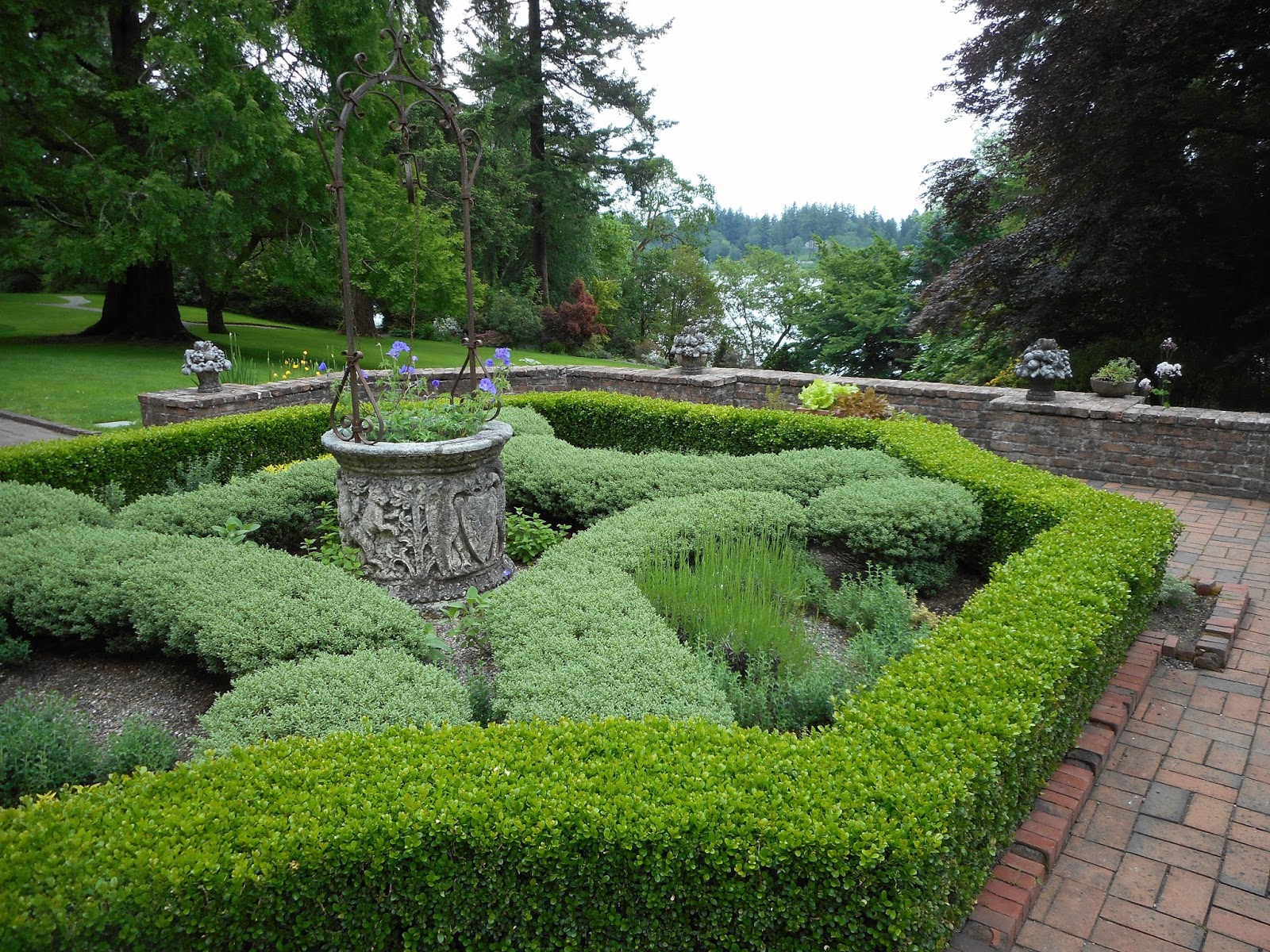
Parterre near the house with Gravelly Lake in the background.  Photos taken in May 2015

Click here to see more photos of Lakewold Gardens.

Lakewold Gardens covers 10 acres on the shore of Gravelly Lake in Lakewood, the southern suburb of Tacoma, Washington.  This is a beautiful garden, surely worth a visit & not far from Interstate 5.

The property was first developed in 1908, but really came into its present form after it was purchased by G. Corydon & Eulalie Wagner in 1938.  The Wagners hired Thomas Church to design the major elements of the garden in 1958.  Based in San Francisco, Thomas Church was one of the most famous landscape architects of his time.  He continued to visit the garden to suggest improvements.  You can see his work in the brick walk, parterres & swimming pool, an unusual mixture of modern & vintage European styles.

Lakewold Gardens also contains quite a lot of woods near the lake & lawn surrounding the house.  The drive is lined with tall Douglas firs & Rhododendron.  Over 900 Rhododendron grow in these gardens.  There is a very charming perennial garden behind the house.

Eulalie Wagner donated the property to the Friends of Lakewold in 1987 to be maintained as a public garden. The State of Washington has made Lakewold Gardens a historic landmark.

Friday, June 5, 2015

Woodland Park Rose Garden


The Woodland Park Rose Garden in June 2014

The Woodland Park Rose Garden covers 2.5 acres at the south entrance to the Woodland Park Zoo, outside the zoo grounds, at the intersection of N 50th Street and Fremont Avenue N, on Phinney Ridge in Seattle.  There are 200 varieties of roses & 3,000 individual plants.  It is one of only two dozen certified American Rose Test Gardens in the United States.  The garden is maintained by the Woodland Park Zoo Society.  Construction of the rose garden was completed in 1924 & originally covered 1.8 acres.  The art deco heritage clearly shows in the design of the pool & frieze behind it.  While not a very small garden, it has an intimate feel, in great contrast to the sprawling Washington Park International Rose Test Garden in Portland, OR.  I have seen a number of other rose gardens, within much larger botanical gardens.  None of them had the subtle charm Seattle's largest rose garden.  There is also the much smaller Helen Sutton Rose Garden located at the South Seattle College Arboretum.

Friday, May 15, 2015

Ell Alley Garden

Native forest garden

Native forest garden

Native meadow

Native meadow

Native & non-native plants in the patio garden.  Photos taken in May 2015.

This is my new garden in Rainier Vista, a neighborhood in Seattle just one mile from my old garden, the Cascadia Garden.  It is 18 months now (May 2015) since I first began to work on this garden.  It has grown amazingly fast, perhaps because it has grown entirely in Cedar Grove compost delivered in November of 2013.  The native soil is clay.  I left that alone & planted in the compost I spread over the clay.  We call this house Ell Alley, because it sits in the ell of 2 alleys that divide our block of 19 new homes into 3 parts.  The Ell Alley Garden also has 3 parts.  The largest part is a Pacific Northwest Coast native garden.  There are also 2 parts with mostly non-native plants, one under the large ash tree in the front & another, much smaller garden, between the patio & the parking pad in the back.

In the native garden, I have used plants that grow in the region that stretches along the coast from northern California to the Alaskan panhandle.  Some plants are shared throughout this area & others do not occur naturally in western Washington.  There is a shaded portion that is planted with forest plants & a sunnier area that is more of a meadow.  I won't include the long plant list here, but it includes Acer circinatum (Vine Maple) Asarum caudatum (Wild Ginger) Blechnum spicant (Deer Fern) Erigeron glaucus (Beach Aster) Fragaria chiloensis (Sand Strawberry) Iris douglasiana (Douglas Iris) Mahonia repens (Creeping Oregon Grape) Penstemon serrulatus (Cascade Beardtongue) Polystichum munitum (Sword Fern) Ribes sanquineum (Flowering Currant) Rubus parviflorus (Thimbleberry) Sambucus racemosa (Red Elderbery) Tellima grandiflora (Fringecup) & Tolmiea meinziesii (Piggyback Plant).

There are many places to find native plants in Seattle.  Many nurseries have sections devoted to native plants.  There are a number of native plants that are commonly used in gardens.  Those are available almost anywhere & include Acer circinatum (Vine Maple) Arctostaphylos uva-ursi (Kinnikinnick) Blechnum spicant (Deer Fern) Erigeron glaucus 'Sea Breeze' (Beach Aster) Polystichum munitum (Sword Fern) Ribes sanquineum (Flowering Currant) & 3 species of Mahonia (Oregon Grape) M. aquifolium, M. nervosa & M. repens.  An excellent source of native plants is at the annual Washington Native Plant Society plant sale.  The West Seattle Nursery had an excellent collection of native plants this year.

Friday, May 1, 2015

Yaquina Head Outstanding Natural Area


Cobble Beach at Yaquina Head.  All photos were taken in April 2014.

Yaquina Head Outstanding Natural Area is truly outstanding.  The head is a model of scenic beauty.  Cobble Beach is an excellent place to peer into tide pools surrounded by birds & seals on the rocky islets & towering headlands.  The visitor's center is polished & informative.  It is set in a beautiful little valley between the high outcroppings of basalt that comprise the headlands.  There is ample parking.  Yaquina Head is easy to find just north of the Newport, OR city center on US Hwy 101.

View from the Visitor's Center.