Tuesday, June 15, 2010

Sidewalk Gardens of Cascadia Ridge

Cascadia Av S Sidewalk Garden June 2010
This parking strip is devoted almost entirely to Lupinus.

Cascadia Av S Sidewalk Garden June 2010
Pavers were set down the center of the parking strip, surrounded with Leptinella squalida. The few shrubs came later, a very welcome addition.  Here is Spiraea japonica 'Goldmound.'

This very small park was developed in 2005 on vacant city land, where Cascadia Av S & Lakewood Av S meet S Ferris St.  It feels very much an extension of the sidewalk.  Here is Iris sibirica.
 
Cascadia Av S Sidewalk Garden June 2010
It's very nice when sidewalk gardens include both sides of the sidewalk.  This garden was completed in 2008.  Lavandula stoechas is a popular sidewalk plant.

Traffic Circle at 37th Av S & S Horton St June 2010
I have nothing but praise for people who garden in Seattle's many tiny traffic circles.  Some generous gardener planted this beautiful Campanula persicifolia.

37th Av S Sidewalk Garden June 2010
I would never put pots out on the sidewalk.  This is the work of a very trusting gardener.  Nice fence, don't you think?

38th Av S Sidewalk Garden June 2010
This garden includes the parking strip on Cascadia Ridge's main arterial, 38th Av S.

Cascadia Ridge is part of the Mount Baker Park neighborhood in the southeastern section of the City of Seattle.  Construction on the neighborhood was begun in 1907, with most houses built by 1930.  The sidewalks are old & cracked.  Sidewalk gardens are a recent addition.  Most have been planted within the past 15 years.

Friday, June 11, 2010

Waterfall at Union Square

2 Union Square April 2010

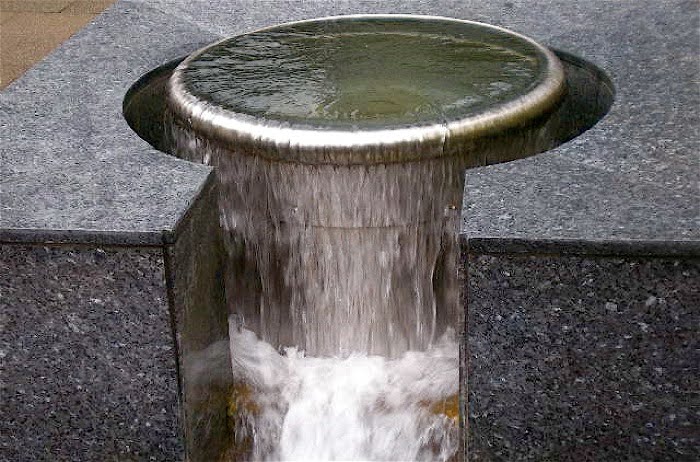
Source of the Waterfall at Union Square April 2010

Waterfall at Union Square April 2010

 Waterfall at Union Square April 2010

Waterfall & Courtyard at Union Square April 2010

The waterfall in the courtyard at Union Square in Downtown Seattle is a treat.  You will find a bountiful amount of splashing water, easy to approach on several levels because it is flanked by flights of stairs.  (Kids are sure to love it!)  The design of the waterfall works well with the tall building (2 Union Square) behind & above it.  The water leads your eye up toward the skyscraper & appears to spring from the tower's base.  There is a 2nd, smaller waterfall across the courtyard.  The planting design isn't wonderful, the paving is mundane & there is very little seating.  But the cascading water is reason enough to visit the courtyard during your jaunt downtown.  It is located very near the center of the retail district at 6th Avenue & Union Street.

Tuesday, June 8, 2010

Azalea Way

Azalea Way May 2010

Azalea Way May 2010

 Quercus robur 'Concordia' May 2010

Tag for Quercus robur 'Concordia'

Magnolia 'Randy' May 2010
 
Magnolia officinalis var. biloba May 2010

 
Kolkwitzia amabilis May 2010

Azalea Way is the most prominent feature of the Washington Park Arboretum in Seattle.  In a rather unusual arrangement, the arboretum is both a city park & the University of Washington Botanic Garden.  The City of Seattle owns the land & the UW owns the plants.  Two sets of gardeners work the Washington Park Arboretum. The city maintains the trails, benches & lawn, while the UW Botanic Gardens maintains the gardens, trees & plant collections. There is more to see along Azalea Way than just azaleas.  Very conveniently, many of the trees & shrubs have tags that say, 'Hello, my name is...'  Early May is prime time for Rhododendron.  But you can also see Magnolia, Syringa & Kolkwitzia.  In April the flowering cherry trees bloom.  It's a charming place & a pleasant walk in any month.  When you start from the Graham Visitors Center, Azalea Way will lead you to the very lovely Japanese Garden.

Friday, June 4, 2010

Harbor Steps

The Harbor Steps April 2010
 
 The Harbor Steps April 2010

The Harbor Steps April 2010

The Harbor Steps in Downtown Seattle is a broad flight of stairs that span the width of University Street between 1st Avenue & Western Avenue.  The planting design is spare & uninspired.  But the hardscape (a series of steps, terraces & expansive water features that qualify as both fountains & waterfalls) is quite nice.  Restaurants & shops line the steps.  There are many places to sit, some with shade from trees.  The land is too steep here to accommodate a street with vehicular traffic.  Before the Harbor Steps were built, there was a fence across a high retaining wall & a narrow staircase.  The Harbor Steps are a very pleasant way to move from Downtown to the Waterfront.  They are directly across from the Seattle Art Museum, very near Benaroya Hall & the Garden of Remembrance, close to the Pike Place Market.  Post Alley connects to the Harbor Steps at their center.

Friday, May 28, 2010

Garden of Remembrance

Garden of Remembrance in Seattle April 2010
 
Garden of Remembrance April 2010

Garden of Remembrance April 2010

Garden of Remembrance April 2010

Garden of Remembrance April 2010

The Garden of Remembrance shares space with Benaroya Hall on 2nd Avenue at University Street in Downtown Seattle.  It is impossible to fault the design in any way.  It is exquisitely tasteful.  The paving & stone work is beautiful.  The planting design is unusually complex for such a small, intensely urban space.  Many trees, a small waterfall & plenty of seating make this a very pleasant, shaded place to rest. The contrast with the nearby Harbor Steps could hardly be greater. This memorial to Washingtonians who died in military conflicts was designed by Murase Associates, with engraved black granite slabs similar to the Vietnam Veterans Memorial in Washington DC.  The Garden of Remembrance is near the Seattle Art Museum & the Pike Place Market.  The University Street Station of the Seattle Transit Tunnel has an exit that leads to the Garden of Remembrance.

Friday, May 21, 2010

Japanese Garden at the Washington Park Aboretum

Japanese Garden at the Washington Park Aboretum April 2010

Japanese Garden at the Washington Park Aboretum April 2010

Japanese Garden at the Washington Park Aboretum April 2010

Japanese Garden at the Washington Park Aboretum April 2010

Japanese Garden at the Washington Park Aboretum April 2010

Japanese Garden at the Washington Park Aboretum February 2010

The best known Japanese Garden in the Seattle area is at the Washington Park Aboretum.  In 2010 the Japanese Garden celebrated its 50th anniversary.  The garden was designed & constructed under the supervision of Japanese garden designer Juki Iida in 1960.  It is a beautiful garden with a magnificent pond fed naturally by the creek that flows through the Washington Park Aboretum.  Whether it is better than the 2 other very good Japanese gardens in the Seattle area, Kubota Garden in the Rainier Beach neighborhood of Seattle & the Yao Japanese Garden at the Bellevue Botanical Garden, is a matter of opinion.  It is certainly more formal & manicured.  Parts of Kubota Garden are much older, but went through a long period of neglect.  The Yao Japanese Garden is newer, but developing very nicely.  If you are a local, you have no excuse not to see all 3.  If you are a tourist, the Japanese Garden at the Washington Park Aboretum is well worth a visit.  It is easily reached by from downtown via the 11 Madison Park bus.  The garden is a short walk from the Washington Park Aboretum bus stop.

Tuesday, May 18, 2010

Colman Park

   
Colman Park May 2010 Lonicera ciliosa

Colman Park May 2010 Lake Washington Boulevard S from the p-patch

Colman Park May 2010 Lysichiton americanum in the muddy pond

Colman Park P-Patch September 2012 Borago officinalis

Colman Park May 2010 path from the p-patch to 31st Avenue S

I think Colman Park in Seattle is the most beautiful of a string of parks along Lake Washington Boulevard.  These parks were created in 1907 (along with the boulevard itself) by Olmsted Brothers, a landscape architecture firm based in Massachusetts.  Their father, Frederick Law Olmsted, had designed Central Park in New York City & Golden Gate Park in San Francisco.  Olmsted Brothers also designed Volunteer Park & Washington Park Arboretum in Seattle.  Seattle Parks & Recreation touts their 'Olmsted Legacy.'  These parks fill ravines along Lake Washington.  From south to north they are Mount Baker Park, Colman Park, Frink Park, Leschi Park & Madrona Park.

Colman Park begins at Lake Washington Boulevard, with parking & benches on the lakeshore.  Pass through 2 period tunnels to ascend the ravine, which is densely filled with native plants.  Midway, you see Lake Washington Boulevard again as it winds through the park.  Here is an expansive lawn that creates a charming & secluded forest glen.  There is very little traffic on this bit of the boulevard.  Skirt the boulevard, then climb an old staircase to cross beneath the boulevard as it snakes back across the ravine on its serpentine path.

Now you are in the upper section of the park, mostly taken up by the Colman Park P-Patch.  Before you climb the terraced gardens, stop to look in the muddy pond, under the trees, in the southeast corner.  You could see a frog.  This picturesque p-patch is enclosed by trees except for the view down the leafy ravine.  Take the steep path, then stairs from the top of the p-patch to 31st Avenue S.  This is a steep climb.  But it is worth the effort to visit Bradner Gardens Park, at 29th Avenue S & S Grand St, 1 block north, 2 blocks west.  Click here to read about more parks along Lake Washington Boulevard.

Friday, May 14, 2010

Asarum caudatum

Asarum caudatum new leaves & flower March 2010

Asarum caudatum old leaves January 2009

Asarum caudatum flower March 2010

Asarum caudatum (Wild Ginger) is a Washington native plant.  It is a small, slow-spreading groundcover for a shaded garden.  Asarum caudatum grows from British Columbia to central California, including Idaho & western Montana.  The leaves stay green through winter, becoming darker & more leathery.  In spring shiny, new, bright-green leaves appear with peculiar purple or red-brown flowers.  The flowers lie upon the ground, often hidden by the leaves.  Asarum caudatum does not need a great deal of water, but don't let it dry out completely in summer.

Tuesday, May 11, 2010

Bradner Gardens Park

S Grand Street & 29th Avenue S May 2010

 
Bradner Gardens Park May 2010

 Gazebo at Bradner Gardens Park May 2010

Tea-kettle-head robot-scarecrow at Bradner Gardens Park May 2010

Tile mosaic in the restroom at Bradner Gardens Park

Wheelbarrows at Bradner Gardens Park

Click here for more pictures of Bradner Gardens Park. 
Click here to see the Bradner Blog.

We begin our tour of Bradner Gardens Park at the corner of S Grand Street & 29th Avenue S in Seattle.  Look at the Downtown skyline.  Views aren't as good from within the park.  Although I have never gardened here, I feel qualified to conduct this tour. This wonderful place is in my own neighborhood of Mount Baker Park, on Mount Baker Ridge, not far from the Mount Baker Tunnel (I-90).  I became very well-acquainted with the site when I spent 6th grade (1970-71) in a portable classroom here.  John Muir Elementary was overcrowded with baby-boomers, 5th & 6th graders moved to this piece of public land.  The remodeled restroom & an asphalt basketball court are all that remain from that time.  

As we enter the park, we see an ornamental demonstration garden to our right & left.  There are many beautiful plants here.  We walk down a few stairs, straight ahead, toward the P-Patch & gazebo.  Seattle Tilth has demonstration gardens here.  Beyond the gazebo we see the restroom/kitchen/meeting-room complex.  Water from the roof is stored in a huge tank.  A windmill & scarecrow stand nearby.  The robotic figure has a tea kettle for a head.  Wheelbarrows are stacked behind the complex.  Beautiful mosaic insects are found on the interior walls of the restroom.  Bradner Gardens Park could easily be the nicest P-Patch in the City of Seattle.

Bradner Gardens Park is just a few blocks northwest of Colman Park.  If you are in the mood for P-Patches, you can find another lovely one there.  Colman Park is quite a treat.  You can walk all the way down the broad ravine to Lake Washington.

Tuesday, May 4, 2010

Armeria maritima

 
Armeria maritima in Seattle May 2010

Armeria maritima on Rousay May 1999

Armeria maritima on Mainland Orkney May 1999

Armeria maritima on Mainland Orkney May 1999

 Armeria maritima in Seattle May 2010

I had Armeria maritima (Thrift) growing in my garden in Seattle when I went to Orkney & saw it there.  I saw it on the island of Rousay, strewn with stray bits of seaweed, growing in cracks in the rocks near the high tide line.  A few days later I saw it on the cliffs above the eastern edge of the Atlantic Ocean at Marwick Head Nature Reserve on Mainland.  Seabirds nested there among the tussocks of thrift.   A few years later I saw it again in Washington Park in Anacortes, on cliffs above the Salish Sea on Fidalgo Island.  I knew it only to be a European plant.  I learned that Armeria maritima is circumboreal, growing near the sea across the northern latitudes.  (According to Stearn maritima means, 'pertaining to the sea; coastal.')  After a while, I removed the last bits of thrift from my garden.  Then I happened to see Armeria maritima on the Greenwalks blog.  I missed the little plant with bright pink flowers.  I had a place for it down by the sidewalk, an environment as challenging as the edge of the sea.  Armeria maritima doesn't require much water.  It's very tough.  It slowly spreads to form a turf-like, tussocky mass.  The only downside is a profusion of dead flower heads in summer.  I cut them off with scissors.