Friday, March 1, 2019

Vallon des Auffes Marseille France

Plage (anse) des Catalans


Monument aux morts de la Porte d'Orient


Vallon des Auffes. Photos taken in February 2017

The Vallon des Auffes in Marseille France is a very charming piece of urban landscape with a small & enclosed harbor.  It is similar to, but much smaller than, the Vieux Port de Marseille.  The word vallon means 'small valley' & auffe is a species of grass (Stipa tenacissima) used to make rope, mats & fishing nets. Many small fishing boats gather here.  The harbor is surrounded by dense housing of many styles & sizes.  I thought the mid-rise residential towers were out of scale.  But after reviewing the photos, I think they make sense.  They are located far enough away not to overwhelm & near enough to provide a picturesque view for their residents.  The elevated bridge of the Corniche du Président John Fitzgerald Kennedy is imposing, yet elegant with its stone facing & 19th-century style.  I walked here from my hotel on la Canebière along the south side of the Vieux Port, then up to the jardin du Pharo, then along the coastline on the corniche, which has ample sidewalks.  I recommend this route.  The jardin du Pharo provides an excellent view of the Vieux Port.  I saw men playing volleyball at the plage (anse) des Catalans. This short bit of coast is lovely.  The monument aux morts de la Porte d'Orient (dedicated in 1927) is impressive & austere in its Art Deco style.  The Vallon des Auffes is quite popular with tourists.  But there were very few people out on the windy & chilly February day I was there.  It felt real in a way that a place with hundreds of tourists never can.  Please compare this small harbor with other waterfront posts on this blog.  Waterfronts are uniquely urban landscapes.

Friday, February 15, 2019

La Vieille Charité Marseille France

The entrance to La Vieille Charité

The portico of the chapel

The rectangular building

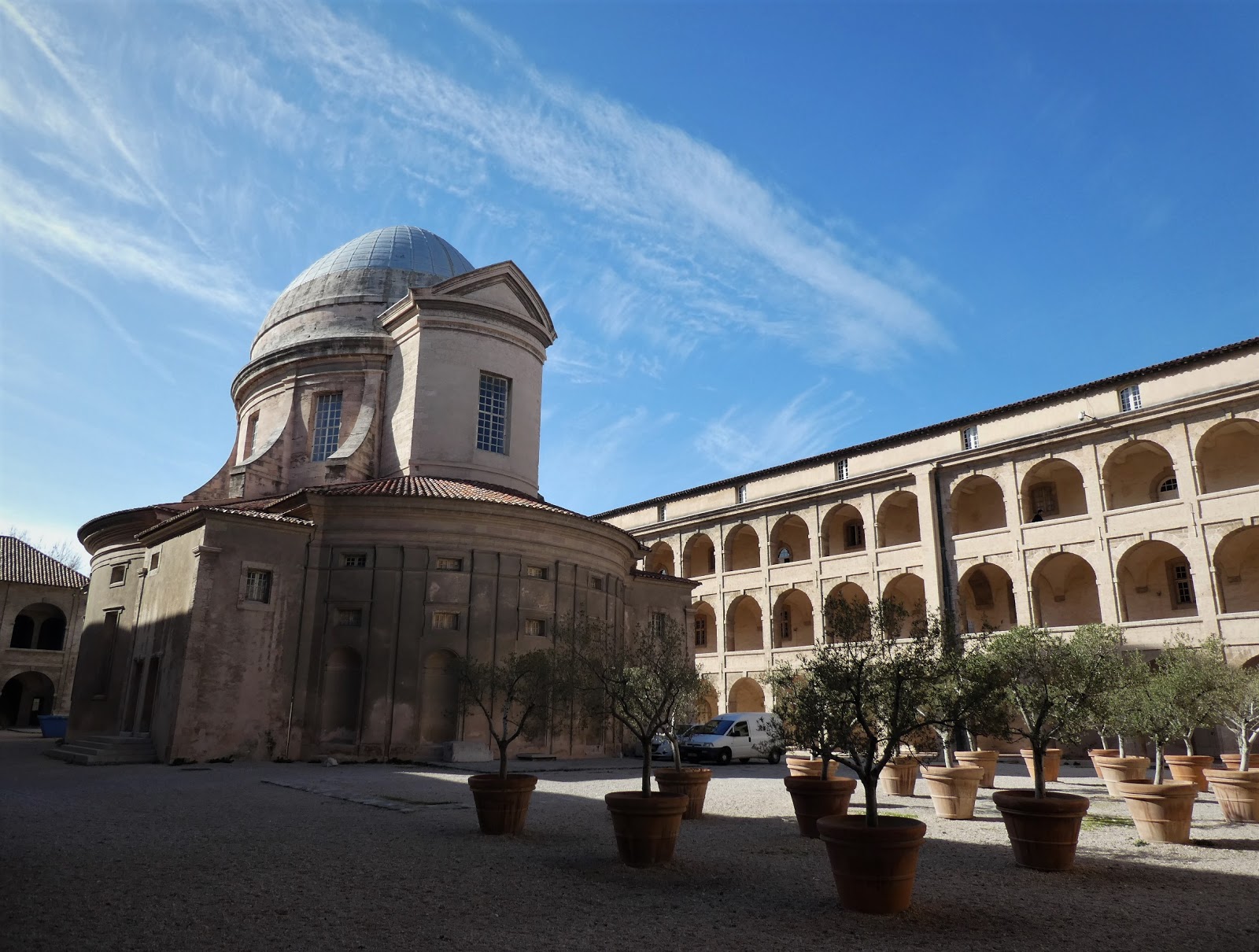
The chapel & courtyard.  Photos taken in February 2017

La Vieille Charité (The Old Charity) in Marseille France is considered a masterpiece of 17th century architectural design. The name of charité is misleading.  Beggars & homeless people were imprisoned here & forced to work, an uncharitable attitude common at the time.  La Vieille Charité is located in the heart of Le Panier, the old city of Marseille.  The grand architecture & open space is quite striking among the narrow streets & modest houses of Le Panier.  La Vieille Charité was built between 1671 & 1749, following the plan of architect Pierre Puget. The larger building is a 3-story rectangle surrounding a courtyard.  A chapel with a portico supported by Corinthian columns is at the center of the courtyard.  The portico is similar to those of Roman temples.  Both buildings are constructed of pink & yellow sandstone from ancient quarries at Cap Couronne.  Although it was not damaged during the French Revolution or WW2, it became quite degraded during more than two centuries of various uses.  La Vieille Charité was restored between 1970 & 1986.  It now houses the Museum of Mediterranean Archaeology & the Museum of Art of Africa, Oceania & Amerindia.  Both are only moderately interesting.  There is also a research library of archaeological documents, a school of advanced studies in social sciences & offices of the Centre National de la Recherche Scientifique (French National Center for Scientific Research).

Friday, February 1, 2019

Le Panier Marseille France


Photos taken in February & March 2017

Le Panier is the Old City in Marseille, France.  People have lived on this piece of land for more than 2,000 years.  This neighborhood was heavily damaged during World War 2, then rebuilt with the same street plan & sometimes the same foundations, as before. This streetscape was not as appealing to me as those in other cities, where the buildings are much older.  These houses look modern.  But the place still has more charm than many urban neighborhoods in the US.  The narrow houses, the street plan that does not conform to a modern grid & the narrow streets that can barely accommodate a car, all that feels intriguingly alien to an American.  How nice it would be, if this plan were adapted for use in modern cities, a respite from too many cars taking up too much space.  Compare this with other old cities that evolved centuries ago & more modern urban landscapes.

Friday, January 18, 2019

MuCEM

The new building seen from Fort Saint-Jean

MuCEM from the Jardin du Pharo

The roof

Fort Saint-Jean from the new MuCEM building

There are walkways like this on every level.

MuCEM in March, 2017

MuCEM (Musée des Civilisations de l'Europe et de la Méditerranée) is a museum in Marseille, France. It is the first museum in the world devoted to Mediterranean cultures. An architectural contest began in October 2002, organized by the Ministry of Culture and of Communication, with 6 teams of architects competing. Rudy Ricciotti was selected in February 2004. MuCEM was inaugurated in 2013, the year Marseille was the European Capital of Culture. About half of the new building is covered by a lacy construction of fiber-concrete meant to resemble fishnet, the most visually interesting part of the design. This covering is called the mantilla, a lace headscarf worn in Spain.  There are walkways on every level between the mantilla & the glass walls.  The building is set on a pier just outside the Vieux (Old) Port & connected by a footbridge to the remodeled Fort Saint-Jean, also part of the museum. Rudy Ricciotti was born in 1952 in Algeria. He studied architecture at the National School of Architecture in Marseille & then engineering at the School of Engineering of Geneva. In 2006, he received the Grand Prix national de l'architecture, a French prize awarded by a jury of twenty persons (under the Ministry of Culture) for recognition of outstanding contribution to architecture.

Friday, January 4, 2019

MuCEM: Le jardin des migrations


These photos were taken on March 12, 2017

Click here for more photos of Le jardin des migrations.
Click here for video of Le jardin des migrations.

This garden at MuCEM is a cultural selection of Mediterranean plants seen & used for millennia by people across the Mediterranean, in a variety of ways.  The plants in this garden have often migrated with those people.  It's a xeric (dry) garden representative of the of Mediterranean climate & necessary in this exposed & windy position on the roofs of the museum.  The garden spreads widely over the the ramparts of the 17th-century Fort Saint-Jean with panoramic views of Marseille, where human migrants arrived long before the earliest recorded settlement by Phoceaen Greeks 2,600 years ago.  15 botanical landscapes include the Garden of Wind, aromatics, Wild Salads of the Fort, a formal myrtle garden, potager, medicinal garden, olive grove & a garden of stone slabs.  They were planted by Olivier Filippi, a nurseryman & Véronique Mure, a botanist.  I was more fascinated with the gardens & the architecture of the fort, than the striking new museum building & the very interesting displays there. 

Friday, December 7, 2018

Vieux Port Marseille France

Northern Bank of the Vieux Port


Eastern Bank of the Vieux Port

Fort Saint-Jean at the entrance to the Vieux Port

Northern Bank of the Vieux Port


Museum of the Roman Docks

La maison Diamantée (ancien hôtel de Saboulin Bollena) Photos taken February & March 2017

Click here for more photos of Marseille.

The Vieux (Old) Port is the visual centerpiece of Marseille, a grand & captivating sight. The most striking feature its almost complete enclosure by the beautiful City of Marseille. It is certainly the main tourist attraction & center of tourist activity. Marseille was founded as a trading port in 600 BC by Greeks from Phocaea. You may see references to the Phocaeans around the city.  They set up a trading post in the hills on the northern bank. Marseille lies in a sheltered depression surrounded by hills. The Vieux Port is a natural harbor similar to many of the inlets along the rocky coastline of the northeastern Mediterranean. 

During Antiquity & the Middles Ages, the Greek, Roman & Medieval city expanded on the northern bank of the Vieux Port.  Growth to the south began in the 17th century.  The Old Port remained the center of maritime activity in Marseille until the 19th century. Between the 15th & 17th centuries, quays were constructed under Louis XII & Louis XIII.  Following a revolt against their governor by the citizens of Marseille, Louis XIV built the forts of St Jean & St Nicolas at the entrance to the Vieux Port.

Axis powers bombed the Port of Marseille in 1940 during World War II.  German forces occupied the Vieux Port from 1942 to 1944. The Vieux Port was a busy center for the French Resistance. In an effort to thwart the resistance, the Germans demolished much of the old quarter (Le Panier). German mines in the Vieux Port created more damage in 1944. After the war, huge reparations were provided by Germany & Italy to compensate for those killed or left homeless by the destruction.

Reconstruction of Le Panier began in 1948.  The medieval plan was retained, streets were rebuilt in place & some houses were rebuilt on the original foundations.  Le Panier is a major tourist site at the Vieux Port.  There is also a quay with ferries to the Iles Frioul, which lie just outside the Vieux Port.  Most interesting to me were the MuCEM (Musée des Civilisations de l'Europe et de la Méditerranée) & the Museum of the Roman Docks (Musée des docks romains).

Friday, November 16, 2018

Vieux Nice France


Photos taken in February 2017

Click here for more photos of Nice.

Vieux Nice is the antique heart of Nice France.  It is also called the Vieille Ville, or Old City.  Vieux Nice was an expansion of the village on the hill above, beginning sometime during the Middle Ages.  The map below shows that Vieux Nice had developed significantly by 1624.

 
I thought Vieux Nice was charming.  It had a theme park atmosphere, with buildings recently painted in rich shades of pink, yellow & orange, as though the city had passed out paint chips.  The streetscape was very appealing to me.  The narrow houses, the street plan that does not conform to a modern grid & the narrow streets that can barely accommodate a car, all create a fantasy landscape that people find intriguingly alien.  How nice it would be, if this were adapted for use in modern cities, a respite from too many cars taking too much space.  I'm thankful places like this still exist & hopeful that similar places may be built now & in the future.  Compare this with other old cities that evolved centuries ago & more modern urban landscapes.