Showing posts with label xeric. Show all posts

Friday, April 5, 2019

Jardin Exotique de Monaco


Photos taken in March 2017

Click here for more photos of Monaco.
Click here for a video of the view of Monaco from the Jardin Exotique.

The Jardin Exotique de Monaco is an extensive & densely planted succulent garden with excellent views of Monaco & the Mediterranean Sea.  This alone would be enough.  But in addition, there are two fascinating sites within the garden.  The first is a deep cave with guided tours.  The second is an engaging museum filled with artifacts found in the cave.  These items date back as far as the Neolithic Period.  There are bones of animals now extinct.  I used to live in the Los Angeles area & have seen many succulent gardens.  The plants here are the same as there: mostly cactus, Aloe, Euphorbia & Agave. Some are quite large.  The garden was dedicated in 1933.

Friday, January 4, 2019

MuCEM: Le jardin des migrations


These photos were taken on March 12, 2017

Click here for more photos of Le jardin des migrations.
Click here for video of Le jardin des migrations.

This garden at MuCEM is a cultural selection of Mediterranean plants seen & used for millennia by people across the Mediterranean, in a variety of ways.  The plants in this garden have often migrated with those people.  It's a xeric (dry) garden representative of the of Mediterranean climate & necessary in this exposed & windy position on the roofs of the museum.  The garden spreads widely over the the ramparts of the 17th-century Fort Saint-Jean with panoramic views of Marseille, where human migrants arrived long before the earliest recorded settlement by Phoceaen Greeks 2,600 years ago.  15 botanical landscapes include the Garden of Wind, aromatics, Wild Salads of the Fort, a formal myrtle garden, potager, medicinal garden, olive grove & a garden of stone slabs.  They were planted by Olivier Filippi, a nurseryman & Véronique Mure, a botanist.  I was more fascinated with the gardens & the architecture of the fort, than the striking new museum building & the very interesting displays there. 

Tuesday, June 20, 2017

Erigeron glaucus


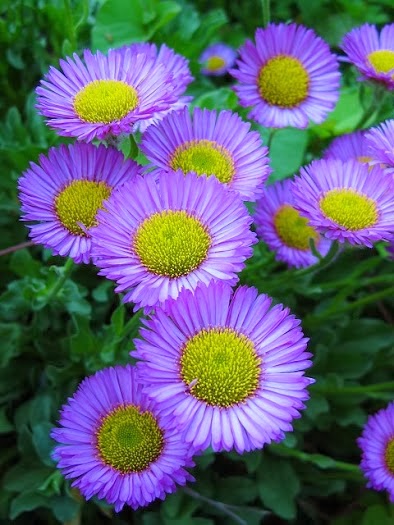
Erigeron glaucus is a very flowerful & easy plant to grow in dry sun.  It blooms continuously through the summer, with the largest number of flowers coming in June.  Bloom can start in April & end in October.  Bees love it.  The normal flower color is blue-lavender.  'Sea Breeze' has pink flowers & seems to be the form most commonly sold in Seattle.  The plant is low & spreading, not more than one foot high & up to 3 feet wide.  It looks nice cascading over rocks & walls.  It is drought tolerant, but can't do entirely without water during the summer.  Water regularly, but not heavily, or more than once a week.  The stems of this plant & sometimes also the leaves survive the winter.  Don't cut it back to the base, just remove the obviously dead parts, mostly the flower heads.  It is native to the California & Oregon coasts, where it grows on bluffs, sand dunes & beaches.

Friday, August 19, 2016

Rosa rugosa


Rosa rugosa 'Hansa'

Rosa rugosa is one of the easiest, most drought tolerant, disease resistant & low-maintenance roses you can grow in Seattle.  It bears attractive flowers, foliage & fruits.  The fruits are large & resemble tomatoes.  Rosa rugosa doesn't often need pruning.  The canes grow to a height of about 3 to 4 feet covered in numerous spines, not the thorns typical of many roses.  Wear gloves when pruning.  The highly fragrant flowers may be single or double in the standard rose colors of red, pink, white & yellow.  Rosa rugosa 'Blanc Double de Coubert' is a popular white rose.  Rosa rugosa has many common names including sea tomato & beach rose.  The name I hear most frequently is rugosa rose.  Rugosa means wrinkled, or rugose.   Rosa rugosa is native to eastern Asia in China, Japan & Korea along the coast, often on sand dunes.  It is considered an invasive species along the coasts of northern Europe & New England.  But this shouldn't be a concern in an urban garden setting.  As with all roses, grow this plant in full sun, in well drained soil.  It blooms in July & August.

Tuesday, July 19, 2016

Acanthus hungaricus


Acanthus hungaricus

Acanthus hungaricus is a fairly common species of Acanthus in Seattle.  It is more tolerant of dryness than Acanthus mollis, which is much more common.  Acanthus hungaricus has beautiful, holly-like foliage that is not at all spiny.  Flowers come in midsummer, with purple bracts forming hoods over white corollas, which line the stems in many tiers to present quite an impressive display of flowers.  The stems may reach 4 feet in height, but more usually 3 feet.  This plant spreads continually, but not very aggressively & will need to be divided when it begins to crowd its neighbors.  Acanthus hungaricus is a perennial plant for full sun in well drained soil.  It is native to Europe in Romania, the Balkans & Greece.  The common name for Acanthus is bear's breeches, in this case Hungarian bear's breeches.  I hear it called Acanthus more often.

Friday, June 17, 2016

Euphorbia nicaeensis


Euphorbia nicaeensis


Euphorbia nicaeensis with Stachys byzantina (Lamb's Ears)

Euphorbia nicaeensis is a perennial plant, evergreen in Seattle, with new stems in spring reaching two feet in length & replacing the stems of the previous year, which wither during the summer, as in many other Euphorbia species.  It blooms in June.  The plant is easy to grow, requires very little water & good drainage.  It is a good candidate for a Mediterranean garden & really quite lovely.  Euphorbia nicaeensis is similar in size & shape to Euphorbia rigida, another worthwhile & more common species.  Euphorbia nicaeensis is a bit difficult to find.  I ordered mine from Joy Creek Nursery in Scappoose, Oregon. Euphorbia nicaeensis is native to Europe in Portugal, Spain, France, Italy & Croatia, as well as Turkey & the Caucasus.  Nicaea was an ancient city which now lies within the modern Turkish city of Iznik.  Nicaea Maritima was the ancient Roman name for the city of Nice, France.  The specific epithet 'nicaeensis' (of Nicaea) can refer to either city, both within the range of this plant.  It was likely observed by the participants of the Council of Nicaea in the year 325, which may be significant to those interested in early Christian history.

Friday, May 20, 2016

Allium karataviense


Allium karataviense is a bulb with a flower about the size of a baseball.  The usual color of the flower is a very pale pink.  Allium karataviense 'Ivory Queen' has white flowers.  There is also an uncommon form named 'Red Globe'.  Allium karataviense blooms in May, earlier than most Allium, which generally bloom in June.  The plant is not very tall, maybe 6 to 8 inches.  Each bulb produces one flower & just a few blue-green leaves.  Allium karataviense spreads slowly by the division of the bulbs & also by seed.  It takes some years for the seedlings to flower, but one flower can produce many seedlings.  A large group of flowers may arise in dry & sunny locations with good drainage in winter.  There is no need for summer water.  Allium karataviense grows naturally in the dry mountains of Central Asia.  It is sometimes called the Turkestan onion.  I think this is one of the more beautiful Allium, both in leaf & in flower.  Rainwater is often cupped at the base of the leaf pairs like sparkling jewels.

Thursday, October 29, 2015

Plants for Dry Sun

Asclepias speciosa (Showy Milkweed)

Rosa rugosa 'Hansa'

Kniphofia 'Percy's Pride' (Torch Lily)

Eryngium amethystinum (Sea Holly)

Hypericum 'Hidcote' (St John's Wort)

This is a list of reasonably drought tolerant plants for full sun, or mostly sun in Seattle.  These plants will need some water during summer, when there is not sufficient rainfall.  They are also not so very xeric as to rot during wet winters, but require good drainage.

Lavandula angustifolia (English Lavender) Lavandula dentata (French Lavender) Lavandula stoechas (Spanish Lavender)
Lithocarpus densiflorus var. echinoides (Dwarf Tanoak)
Myrtus communis (Common Myrtle)
Olearia x haastii, Olearia x mollis
Phlomis fruticosa (Jerusalem Sage) & other species
Potentilla fruticosa (Cinquefoil)
Rosa rugosa (Sea Tomato)
Santolina chamaecyparissus (Lavender Cotton)
Senecio monroi (name changed to Brachyglottis)
Yucca filamentosa ‘Color Guard’, Yucca filamentosa ‘Bright Edge’ (Yucca)

Perennials
Achillea millefolium (Yarrow)
Allium (Ornamental Onion) many species
Armeria maritima (Thrift)
Asclepias tuberosa (Orange Milkweed) Asclepias speciosa (Showy Milkweed)
Aster (Michaelmas Daisy)
Baptisia australis (False Indigo)
Camassia leichtlinii, Camassia quamash (Camas)
Crocus many species
Echinops ritro (Globe Thistle)
Echinacea purpurea (Purple Coneflower)
Erigeron glaucus (Beach Aster) Erigeron karvinskianus (Santa Barbara Daisy) Erigeron speciosus (Showy Fleabane) & others
Eryngium amethystinum, Eryngium bourgatii, Eryngium variifolium (Sea Holly) & others
Euphorbia characias, Euphorbia x martinii, Euphorbia rigida (Spurge): & others
Geranium cantabrigiense, Geranium sanguineum (Cranesbill) & others
Helianthemum nummularium (Sunrose)
Helenium autumnale (Sneezeweed)
Hemerocallis (Daylily)
Hyacinthus orientalis (Hyacinth)
Iris douglasiana (Douglas Iris)
Kniphofia (Torch Lily)
Lobelia tupa (Tupa)
Ornithogalum umbellatum (Star of Bethlehem)
Paeonia (Peony)
Panicum virgatum (Switchgrass)
Romneya coulteri (Matilija Poppy)
Salvia (Sage)
Scilla peruviana (Giant Squill)
Tulipa batalinii, Tulipa turkestanica (Tulip) & other species
Scrophularia macrantha
Sedum 'Autumn Joy', Sedum 'Matrona', Sedum 'Vera Jameson' (Stonecrop) & others

Groundcovers
Arctostaphylos x media (A columbiana x A uva-ursi) Arctostaphylos nevadensis (Pinemat Manzanita) Arctostaphylos uva-ursi(Kinnikinnick) & other species
Aubrieta deltoidea (Rock Cress)
Aurinia saxatilis (Basket of Gold)
Campanula carpatica (Carpathian Harebell)
Ceanothus gloriosus (Point Reyes Ceanothus) Ceanothus griseus var. horizontalis (Carmel Creeper)
Hebe glaucophylla, Hebe x pimeleoides, Hebe pinguifolia 'Pagei' (Hebe)
Hypericum cerastioides (St John’s Wort)
Juniperus conferta (Shore Juniper) Juniperus procumbens (Japanese Garden Juniper) Juniperus squamata 'Blue Carpet'
Lithodora diffusa (Lithodora)
Penstemon pinifolius (Pineleaf Beardtongue)
Rosmarinus officinalis ‘Prostratus’ (Trailing Rosemary)
Sedum oreganum, Sedum reflexum 'Angelina', Sedum spathulifolium 'Cape Blanco', Sedum spurium (Stonecrop) & others
Veronica pectinata (Woolly Speedwell) Veronica prostrata (Harebell Speedwell)

Friday, May 30, 2014

Erigeron speciosus

Erigeron speciosus 'Darkest of All' in the Ornamental Border at Bradner Gardens Park in June 2013

 
 Erigeron speciosus 'Prosperity' in the Cascadia Garden in June 2010
 
Erigeron glaucus in the Cascadia Garden in June 2012

Erigeron species at Frenchman Coulee near Vantage WA in May 2013 

Erigeron species at Crab Creek near Moses Lake WA in May 2013

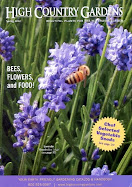
This is a post about Erigeron speciosus & High Country Gardens.  Erigeron speciosus (Showy Fleabane) is a perennial with beautiful flowers, widespread in the western US, including Washington.  There are quite a number of cultivars & hybrids in various shades of blue, lavender & pink.  It grows to a height of about 30 inches.  It is a low maintenance & fairly drought tolerant plant.  While I'm at it, I'll also mention Erigeron glaucus & Erigeron in general. I think Erigeron glaucus is the most beautiful & useful species of the genus in Seattle.  It blooms for a very extended period from May through October & is highly drought tolerant.  The flowers are as large as Erigeron speciosus, but the plant is low & spreading.  The genus Erigeron has almost 400 species growing in a variety of conditions throughout the northern hemisphere.  Eastern Washington has a number of small species adapted to very dry conditions.  Two of them appear above.

In January of 2014, I received this message via email: I noticed a photo of Erigeron 'Darkest of All' on the blog The Ornamental Border at Bradner Gardens Park on July 6, 2013.  High Country Gardens is offering this plant for our Spring 2014 season and we are in need of a photo for our website.  We were wondering if you would allow us to use the photo.  If this is something you would  be willing to do we would be happy to send you a High Country Gardens gift certificate as a thank you.

I was happy to receive a gift certificate for $50, because I have high regard for High Country Gardens.  I ordered plants from them several times for the Cascadia Garden.  They were always in excellent condition.  High Country Gardens sells plants for the arid western US.  Many of their plants have limited use in Seattle.  But some are worth trying on dry sites, in pots filled partly with gravel, & under the overhangs on the south or west walls of buildings where they get a limited amount of rainfall.  Others, like Erigeron speciosus, grow well along the Pacific northwest coast.

Tuesday, July 3, 2012

Cork Oak in the Washington Park Arboretum

Quercus suber in the Washington Park Arboretum November 2011

 Quercus suber in the Washington Park Arboretum November 2011

 Quercus suber in the Washington Park Arboretum November 2011

Quercus suber in the Washington Park Arboretum November 2011

I don't often see Quercus suber in Seattle.  There is this tree in the Washington Park Arboretum, just east of the East Drive, not far north of the Pacific Rim Garden.  There is another Downtown on 2nd Avenue & others in the comma at the north end of Hunter Boulevard S near my home.   I think there are not enough specimens to determine whether Cork Oak is a good choice for Seattle.  But it would certainly be worth trying on a dry & sunny site.

This information from Wikipedia:
Quercus suber has a thick bark that protects it against fire. After a fire, many other tree species regenerate from seeds, or resprout from the base of the tree.  Cork Oak branches quickly resprout & recompose the tree canopy. Over time the cork layer of bark becomes quite thick.  It can be harvested every 9 to 12 years. The harvesting of cork does not harm the tree. After cork is removed, a new layer regrows. The tree is cultivated in Portugal, Spain, France, Italy, Morocco, Algeria & Tunisia. Cork Oak forests cover approximately 25,000 square kilometers in those countries. In Portugal & Spain, Cork Oak forests are home to the Iberian Lynx, the most critically threatened feline in the world. Portugal accounts for half of the world cork harvest. Cork Oaks cannot legally be cut down in Portugal, except for the felling of old, unproductive trees, with special permission from the Ministry of Agriculture. Cork Oaks can live to 250 years. Cork harvesting is done entirely without machinery. It is harvested with small axes. This process requires training due to the skill required to harvest cork without harming the tree.

Friday, December 17, 2010

Pacific Northwest Dry Forest Garden

Arbutus unedo October 2010

Pinus monticola August 2008

Mahonia repens July 2010

Trillium ovatum March 2010

 Ribes sanguineum March 2010

Unless you have very many acres, this garden would more accurately be called a bosque, than a forest.  A bosque is a grove of trees, either in nature, or in landscape design.  I’m not sure how the word crept into landscaping.  It is a Spanish word meaning forest in the larger sense, as in the bosque amazonico, the Amazon Rain Forest.  In American landscape design, the word is pronounced ‘bosk,’ while in Spanish it has 2 syllables.  The French use the word ‘bosquet’ to describe a grove, usually contrived.  There are famous bosquets at the château de Versailles

This garden (or bosque) is designed entirely with plants from dry forests of the coastal Pacific Northwest, although some also grow in moist forests.  Plant this garden in sun with some slope (so that is sure to drain) or on ground that is already known to be dry.  The understory (everything but the trees) will grow in shade.  The trees want sun.  This is intended to be a garden of light, dappled shade.  Don’t plant the trees too close together.  Arbutus menziesii (Madrona) does not form a dense canopy.  Pinus ponderosa (Ponderosa Pine) is an open & slender tree.  Thuja plicata ‘Fastigiata’ (Hogan Cedar) is a columnar form of Western Red Cedar.  Pinus monticola (Western White Pine) & Quercus garryana (Garry Oak) are more spreading.  Use fewer of them, spaced widely apart.   This garden won’t need irrigation beyond the 1st few summers.  

To read more about these plants, get a copy of Plants of the Pacific Northwest Coast by Jim Pojar & Andy MacKinnon.

Pacific Northwest Dry Forest Garden Plant List
Trees
Acer circinatum (Vine Maple)
Amelanchier alnifolia (Saskatoon)
Arbutus menziesii (Madrona)
Pinus monticola (Western White Pine) Pinus ponderosa (Ponderosa Pine)
Quercus garryana (Garry Oak)
Thuja plicata ‘Fastigiata’ (Hogan Cedar)

Shrubs
Gaultheria shallon (Salal)
Mahonia aquifolium (Oregon Grape) Mahonia nervosa, Mahonia repens
Holodiscus discolor (Oceanspray)
Juniperus communis (Common Juniper)
Oemleria cerasiformis (Indian Plum)
Philadelphus lewisii (Mock Orange)
Rhododendron macrophyllum (Pacific Rhododendron)
Ribes sanguineum (Flowering Currant)
Rosa gymnocarpa (Dwarf Rose)
Symphoricarpos albus (Snowberry)
Vaccinium ovatum (Evergreen Currant)

Perennials
Achlys triphylla (Vanilla Leaf)
Allium cernuum (Nodding Onion)
Festuca idahoensis (Idaho Fescue)
Lilium columbianum (Tiger Lily)
Polystichum munitum (Western Sword Fern)
Tellima grandiflora (Fringecup)
Trillium ovatum (Wake Robin)
Viola adunca (Early Blue Violet)

Groundcovers & Trailers
Arctostaphylos uva-ursi (Kinnikinnick)
Dicentra formosa (Bleeding Heart)
Fragaria vesca (Woodland Strawberry)
Lonicera hispidula (Hairy Honeysuckle)
Maianthemum dilatatum (False Lily of the Valley)
Smilacina stellata (aka Maianthemum stellatum)

Pacific Northwest Dry Forest Garden Plan
Trees
ACE = Acer circinatum (Vine Maple)
AME = Amelanchier alnifolia (Saskatoon)
ARB = Arbutus menziesii (Madrona)
PINE = Pinus ponderosa (Ponderosa Pine)

Shrubs
GAU = Gaultheria shallon (Salal)
MAH = Mahonia aquifolium (Oregon Grape)
HOL = Holodiscus discolor (Oceanspray)
PHI = Philadelphus lewisii (Mock Orange)
RHO = Rhododendron macrophyllum (Pacific Rhododendron)
RIB = Ribes sanguineum (Flowering Currant)
VAC = Vaccinium ovatum (Evergreen Currant)

Perennials
ACH = Achlys triphylla (Vanilla Leaf)
ALL = Allium cernuum (Nodding Onion)
ERY = Erythronium oregonum (Fawn Lily)
LIL = Lilium columbianum (Tiger Lily)
POL = Polystichum munitum (Western Sword Fern)
TEL = Tellima grandiflora (Fringecup)
TRI = Trillium ovatum (Wake Robin)
VIO = Viola adunca (Early Blue Violet)

Groundcovers & Trailers
ARC = Arctostaphylos uva-ursi (Kinnikinnick)
DIC = Dicentra formosa (Bleeding Heart)
SMI = Smilacina stellata (aka Maianthemum stellatum)

Friday, December 10, 2010

The Heathland Garden

Phlomis italica October 2010

Digitalis obscura June 2009

Allium karataviense May 2010

Lithocarpus densiflora var. echinoides October 2010

Calluna vulgaris 'Wickwar Flame' & Hebe x pimeleoides 'Quicksilver' October 2010

Hebe ochracea October 2010

Thymus pseudolanuginosis October 2010

Arctostaphylos columbiana (foreground) & Erica arborea 'Estrella Gold' May 2010


The Heathland Garden is a shrubby landscape, reminiscent of the moorlands of England, the heathlands of Scotland, & the alpine shrublands of New Zealand.  In addition to heath (Erica) & heather (Calluna), I have chosen xeric plants from the maquis shrubland of the Mediterranean Basin, plus some xeric plants from the Pacific Northwest.  The Heathland Garden combines plants from all of these places to form a dense tapestry of low shrubs & perennials, enclosed by a few taller shrubs.  This is a colorful garden, with blue-gray & yellow-gold foliage year round & perennial flowers in season.  Although it is not a highly xeric garden, it will only need occasional irrigation during Seattle summers.  I've found that Calluna & Hebe cannot go entirely without summer irrigation.  This garden must be planted in full sun.

Plan for the Heathland Garden
Heathland Garden Plant List
Shrubs
AC = Arctostaphylos columbiana (Hairy Manzanita)
AP = Arctostaphylos ‘Pacific Mist’ (Manzanita)
BRA = Brachyglottis monroi (aka Senecio monroi)
CAL = Calluna vulgaris ‘Wickwar Flame’ (Heather)
DAB = Daboecia cantabrica (Irish Heath)
EA = Erica arborea ‘Estrella Gold’ (Tree Heath)
HO = Hebe ochracea
HP = Hebe x pimeleoides ‘Quicksilver’
HT = Hebe topiaria
LIT = Lithocarpus densiflorus var. echinoides (Dwarf Tanoak)
OLE = Olearia x mollis
PHL = Phlomis italica
VAC = Vaccinium ovatum (Evergreen Huckleberry)

Perennials
ALC = Alchemilla mollis (Lady's Mantle)
ALL = Allium karataviense
CAM = Camassia quamash (Camas)
CRO = Crocus sieberi ‘Firefly’
DIG = Digitalis obscura (Foxglove)
ERI = Erigeron glaucus (Beach Aster)
EUP = Euphorbia rigida
HEL = Helleborus argutifolius (Corsican Hellebore)
IRI = Iris tenax

Groundcovers
HYP = Hypericum cerastoides (St John's Wort)
SED = Sedum ‘Vera Jameson’
THY = Thymus pseudolanuginosus (Woolly Thyme)

Allow Hebe x pimeleoides ‘Quicksilver’ to interweave with Calluna vulgaris ‘Wickwar Flame’ & Daboecia cantabrica.  In general, there should be very little need for pruning iin this garden.