Showing posts with label Bloedel Reserve. Show all posts

Friday, August 26, 2011

The Bloedel Reserve

A storage barn at the south end of the West Meadow, looking north.  Your visit to the Bloedel Reserve starts at the north end of the meadow, seen in the distance, near the parking lot.

Not long after you enter the woods at the south end of the West Meadow, you come upon a large pond, which is the Bird Refuge.  'The refuge islands in this large pond provide a year-round home for ducks, geese and a new resident beaver. A variety of migratory ducks spend their winters here, and kingfishers and great blue herons feast on the small amphibians and fish found in the pond. The shoreline is ringed with native western azaleas, viburnums, red and yellow osier dogwoods, and red alders.' from the Bloedel Reserve website.

Shortly after passing the Bird Refuge, you re-enter the woods.  (The brochure says, 'you next step abruptly into a dense forest.' But it didn't feel abrupt to me.  Most of the reserve is forest with a few open areas carved from it.)  'In this dense Northwest forest, Douglas fir, western red cedar and hemlock, festooned with moss, stand undisturbed along the trail. Two man-made features offer unique views of the woods. A tall trestle bridge gives you a bird’s-eye look down at a year-round stream. A boardwalk across wetlands allows you to enter a bog filled with chorusing frogs and carnivorous plants.' from the Bloedel Reserve website.

Lysichiton americanum in the bog, seen from the boardwalk.

Salix babylonica beside the Mid Pond.  'Your next steps take you from the deep woods into a formal European landscape accented by lakes, towering English elms and a stately weeping willow, with a dramatic view of the Bloedel’s former residence.  This French country-style home, now our Visitor Center, commands a view of Puget Sound’s Port Madison Bay near Agate Pass. An active eagle’s nest is visible from the east lawn.  Flanked by a gracious living room and dining, the central room in the Bloedel’s former residence houses a cozy Library with a collection of 1,400 horticultural and botanical books, available for reading and research on site.' from the Bloedel Reserve website.  Next come The Glen, The Japanese Garden & The Moss Garden, which are the subjects of separate posts.

From the Moss Garden, you enter the Reflection Garden.  'The basic elements – earth, sky, trees and still water – create the Reflection Pool, a setting of magical simplicity. The pool and hedge tame the forest with geometric precision, and the mirror-like pool invites quiet contemplation.' from the Bloedel Reserve website.

Finally, you re-enter the West Meadow at its mid-point & return to the parking lot.  These photos were all taken in April 2011.

Map of the Bloedel Reserve from the brochure.

The Bloedel Reserve in Bainbridge Island, Washington near Seattle is one of the finest gardens in the United States.  Prentice & Virginia Bloedel resided on the property from 1951 to 1986. They developed the 150-acre property, mostly 2nd-growth forest, into the present series of gardens.  The Arbor Fund, established and endowed by the Bloedels in 1974, purchased the Bloedel Reserve in 1985 & continues to manage it.  One of the 1st to work on the Reserve, under the Bloedels, was Ray Prentice of Prentice Nursery in Seattle.  He built the waterfall & planted shrubs & trees on the waterfall bank.  The famous landscape architect Thomas Church of San Francisco began working with the Bloedels in 1954.  He prepared conceptual drawings for the Mid-Pond area that became the scenic driveway loop.  He also designed the Waterfall Overlook, the Orchid Trail (1st called the Church Walk) & the Reflection GardenFujitaro Kubota of Kubota Nursery in Seattle designed & installed the Japanese Garden in 1961.  The Zen Garden was designed by Koichi Kawana, professor of landscape architecture at UCLA.

In the Treaty of Point Elliott, signed by Chief Seattle in 1855, the Suquamish Tribe ceded Bainbridge Island to the US government.  By the late 1800s, Bainbridge Island was home to the world's largest sawmill, the Port Blakely Mill, which closed in the mid 1920s.  Many of the mill workers were Japanese.  In 1942 Bainbridge Island became 1 of the first communities required to respond to Executive Order 9066, which removed those of Japanese ancestry to internment camps.  220 Japanese-Americans were sent to Manzanar on the edge of the Mojave Desert, and then to Minidoka in Idaho.  The novel Snow Falling on Cedars by David Guterson is set on Bainbridge Island.

Friday, July 15, 2011

Bloedel Reserve: The Japanese Garden

The Zen Garden by Koichi Kawana at the Bloedel Reserve April 2011


The Japanese Garden by Fujitaro Kubota at the Bloedel Reserve April 2011


The Bloedel Reserve in Bainbridge Island, Washington near Seattle, is an award-winning series of gardens covering 150 acres.  'Designed by Seattle landscape designer and nurseryman Fujitaro Kubota, the elegant landscape of the Japanese Garden offers subtly shifting views along its meandering stroll paths. The coniferous trees surrounding the garden provide a dark backdrop for the bold colors of Japanese maples and meticulously-pruned pines and flowering trees. The elements of stone and sand evoke meditative moods in the Zen Garden, designed by Koichi Kawana, professor of landscape architecture at the University of California.' (UCLA) from the Bloedel Reserve website.  The garden was named the 5th highest quality Japanese garden in the United States by the Journal of Japanese Gardening in 2004.  1st installed in 1961, it was renovated in 2010.  'The guest house is a subtle blend of traditional Japanese tea house & Pacific Northwest Indian longhouse.' from the Bloedel Reserve brochure.  I found it a unique & interesting structure, but I would not call it subtle.  It was designed by Paul Haden Kirk.  You can see the complete mid-century furnishings through the windows, which is a treat.  Among many other gardens, Fujitaro Kubota designed & built the display gardens at his nursery in Seattle, now known as Kubota Garden.

Friday, June 24, 2011

Bloedel Reserve: The Moss Garden


The Moss Garden at Bloedel Reserve April 2011

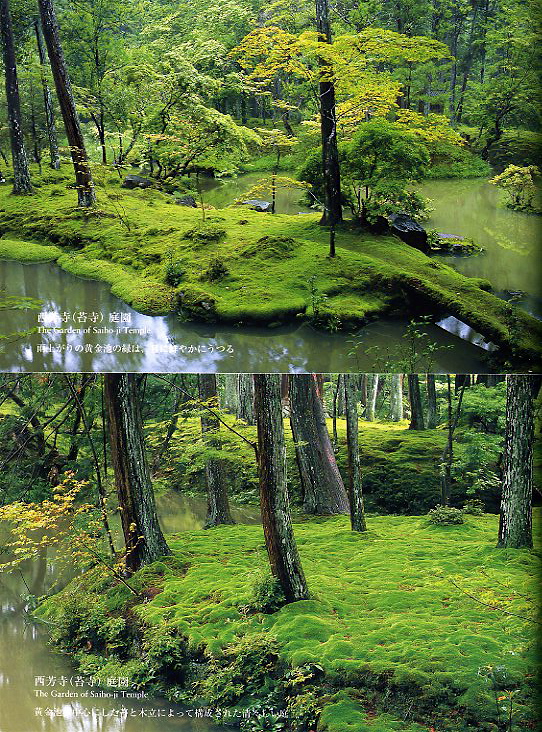
In a series of coincidence, Rusty gave me the photographic book The Japanese Gardens: Kyoto for my birthday in March 2011.  The April 2011 issue of Garden Design included an article about moss in the gardens of Kyoto.  Rusty & I saw the Moss Garden at the Bloedel Reserve in Bainbridge Island, Washington near Seattle, also in April 2011.  In Garden Design: A World Apart, Susan Heeger wrote of the Moss Garden at Saiho-ji, “The Garden’s most celebrated aspect, the legion of mosses in different shades of green that swath hummocks & hills & mounds around the pond, almost certainly arose on its own in the humid climate.  The verdant carpet sprouted & spread on these shady slopes, suggesting a place much more natural than designed. ‘Mosses invited themselves into the gardens of Japan & thereby invented moss gardening,’ George Schenk wrote in Moss Gardening, his authorative book.”  The famous Moss Garden of Saiho-ji is found in a grove surrounding the Golden Pond, where the growth of more than 120 species of mosses is said to have started after a flood. ‘Outside of Japan, ground-covering mosses more extensive than a few square yards remain rare in gardens,’ writes George Schenk in Moss Gardening.  I was unable to find information about the origin of the Moss Garden at Bloedel Reserve.  But the entire Reserve lies in a very moist micro-climate.  There are many ponds, bogs & streams.  Moss is everywhere, clinging to trees & shrubs, covering areas of forest floor.  In the Moss Garden, moss carpets the ground in a large, boggy area drained by small channels of flowing water & shaded by native conifers. The Moss Garden is adjacent to the Japanese Garden. The path curves through on its way to the Reflection Pool.  Unlike the Japanese Garden, the Moss Garden looks very natural to western Washington, although unnaturally open & clear of debris.  700 species of mosses grow along the Pacific Northwest Coast.  The Bloedel Reserve website provides this short description, ‘In this hushed garden room, with its dense living carpet, wiry huckleberries spring from decaying stumps and huge skunk cabbages crowd the dampest places under a canopy of lacy angelica trees, creating a mysterious  landscape.’

The Moss Garden at Saiho-ji from The Japanese Gardens: Kyoto

Tuesday, April 19, 2011

Bloedel Reserve: The Glen in April

 Eythronium & Primula April 2011
 
Oxalis April 2011

Pulmonaria April 2011

Trillium April 2011

Trillium April 2011

On the third weekend in April 2011, the Bloedel Reserve in Bainbridge Island, Washington near Seattle, hosted it's very first Premier Plant Sale & Open House.  Admission was free both days.  Much of the Reserve's 150 acres is forested.  The floor of the shaded Glen is covered with woodland perennials.  In April this was an amazing sight.  Great numbers of Anemone, Brunnera, Dicentra, Erythronium, Omphalodes, Primula, Pulmonaria & Trillium bloomed amid a carpet of Oxalis.  According to the website, 'Dozens of rhododendron species thrive in the Glen under the protection of second-growth forest. Thousands of perennials, bulbs and wildflowers bloom among the rhododendrons, including one of the largest cyclamen plantings in the world. The Bloedel Reserve was created by Prentice Bloedel and his wife, Virginia, who resided on the property from 1951 until 1986.'