Showing posts with label sidewalk gardens. Show all posts

Friday, August 26, 2016

Plants for Parking Strips

 Hebe recurva

Epimedium colchicum

Iris douglasiana

Erigeron glaucus 'Sea Breeze'

Hebe pinguifolia 'Pagei'

This is a list of plants under 3 feet tall for parking strips. None of these plants need a lot of water. Some of them are xeric plants. The shrubs & perennials don’t spread very much. The groundcovers do spread, but not very widely. The Seattle Department of Transportation (SDOT) requires that plants in parking strips are not more than 3 feet tall. This helps keep pedestrians & cars visible, increasing safety.  Don't plant anything but very low groundcovers near fire hydrants.

Shrubs (evergreens for sun, except as noted)
Berberis thunbergii ‘Bagatelle’ (Japanese Barberry): deciduous
Calluna vulgaris (Heather)
Daboecia cantabrica (Irish Heath)
Dorycnium hirsutum (Hairy Canary Clover): xeric
Erica erigena (Irish Heath)
Erica x griffithsii (Griffith’s Heath)
Erica manipuliflora (Autumn Heath)
Erica terminalis (Corsican Heath): to 3 feet tall
Hebe ochracea (Whipcord Hebe)
Hebe x pimeleoides ‘Quicksilver’ (Quicksilver Hebe)
Hebe recurva (Recurved Hebe)
Hebe ‘Red Edge’ (Red Edge Hebe)
Helichrysum italicum (Curry Plant): xeric
Hypericum x moserianum ‘Tricolor’ (Tricolor St John’s Wort)
Juniperus squamata ‘Blue Star’ (Blue Star Juniper)
Pieris japonica ‘Bisbee Dwarf’ (Bisbee Dwarf Pieris): shade
Pinus mugo ‘Valley Cushion’ (Valley Cushion Mugo Pine)

Perennials (deciduous plants for sun, except as noted)
Achillea millefolium (Yarrow): xeric
Agapanthus campanulatus (Lily of the Nile)
Alchemilla mollis (Lady’s Mantle): shade
Anemanthele lessoniana (Pheasant’s Tail Grass)
Aruncus aethusifolius (Korean Goat’s Beard): shade
Bergenia (Elephant Ears): evergreen, sun or shade
Campanula glomerata (Clustered Bellflower)
Carex (Sedge): many species & cultivars
Crocosmia crocosmiiflora ‘Emily McKenzie (Flaming Iris): xeric
Dryopteris erythrosora (Autumn Fern): shade
Echinacea purpurea (Purple Coneflower): xeric
Epimedium (Bishop’s Hat): evergreen, shade
Erigeron glaucus (Beach Aster): xeric
Festuca ovina ‘Elijah Blue’ (Blue Fescue): evergreen, xeric
Geranium cantabrigiense (Cranesbill)
Geranium sanguineum (Bloody Cranesbill)
Helleborus argutifolius (Corsican Hellebore): evergreen, sun or shade, xeric
Helleborus x hybridus (Lenten Rose): evergreen, shade, xeric
Helleborus x sternii (Hellebore): evergreen, shade, xeric
Hemerocallis (Daylily)
Liriope muscari (Lily Turf): evergreen, shade, xeric
Luzula sylvatica (Wood Rush): evergreen, shade
Iris douglasiana (Douglas Iris): evergreen, xeric
Iris, Pacific Coast Hybrids (Pacific Coast Hybrid Iris): evergreen, xeric
Pennisetum setaceum (Fountain Grass)
Polystichum munitum (Western Sword Fern): evergreen, shade
Rudbeckia hirta (Blackeyed Susan): xeric
Sedum ‘Autumn Joy’ (Stonecrop): xeric
Sedum ‘Matrona’ (Stonecrop): xeric

Groundcovers (some spread modestly, others quite a lot)
Armeria maritima (Thrift): xeric, forms small mats
Aubrieta deltoidea (Rock Cress): forms mats, spreads by seed
Aurinia saxatilis (Basket of Gold): xeric, forms low mounds, spreads by seed
Campanula carpatica (Carpathian Harebell): forms slowly spreading mounds
Hebe pinguifolia 'Pagei': forms low mats
Helianthemum nummularium (Sunrose): xeric, forms low mats
Hypericum cerastioides (St John’s Wort): xeric, forms small mats
Iberis sempervirens (Evergreen Candytuft): xeric, spreads moderately to form mounds
Juniperus procumbens (Japanese Garden Juniper): xeric, forms mats
Juniperus squamata 'Blue Carpet' (Blue Carpet Juniper): xeric, forms mats
Pratia pedunculata (Blue Star Creeper, formerly Laurentia fluviatilis): very low, wide-spreading
Rosmarinus officinalis ‘Prostratus’ (Trailing Rosemary): xeric, spreading shrub
Sedum reflexum 'Angelina' (Stonecrop): xeric
Sedum spathulifolium 'Cape Blanco' (Stonecrop): xeric
Thymus serpyllum (Creeping Thyme): xeric, forms very low mats
Thymus pseudolanuginosus (Woolly Thyme): xeric, forms very low mats

Friday, April 3, 2015

Barbie's Garden


These photos were taken in October 2014.

Barbie's Garden is on my street in the next block south of my house.  The house was built in 2013, along with 11 others of the same shape & size (tall & narrow) in the Rainier Vista development in Seattle.  I call it Barbie's Garden because of the candy colors that remind me of Barbie's Dream House.  I spoke to the woman who lives there.  She told me the garden was created by her sister.  Plants in Barbie's Garden include Canna, Dahlia, Lantana, Zinnia & Pink Polka-Dot Plant (Hypoestes phyllostachya) which is just perfect for Barbie.  Many of these are annual plants.  I wonder what will replace them next season.  It is the most interesting & best-maintained garden on that block & perhaps in all of Rainier Vista, which has a lot of dismal landscaping.

Friday, August 15, 2014

Sidewalk Garden on SW Juneau Street

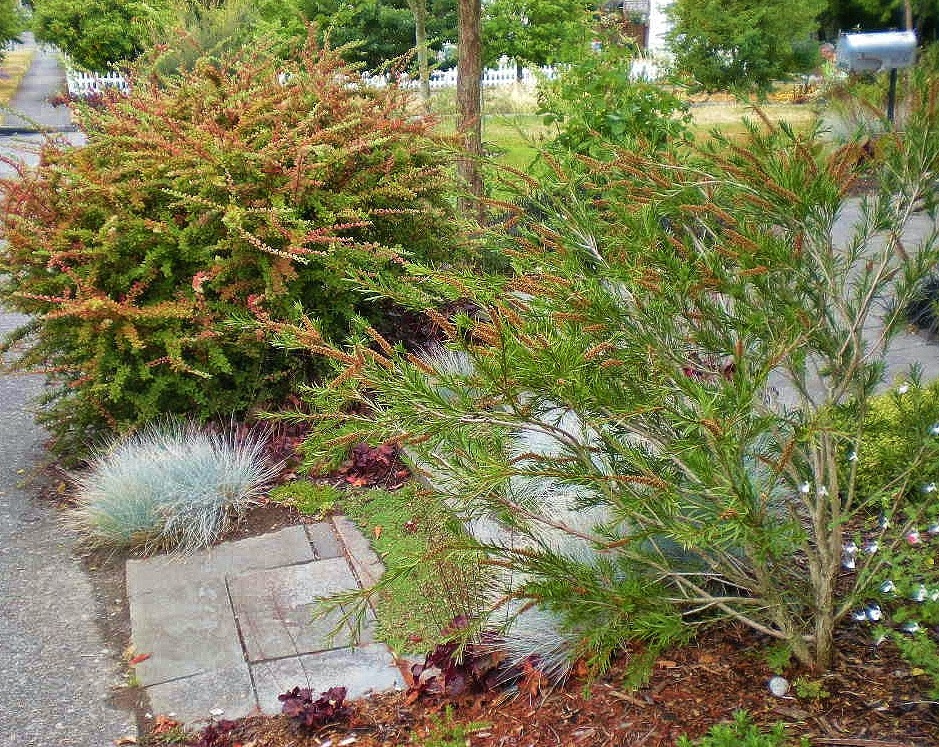
Berberis thunbergii, Grevillea victoriae & Nassella tenuissima on SW Juneau Street in August 2013


Callistemon (Bottlebrush) & Berberis (Barberry) on SW Juneau Street in August 2013


Rudbeckia hirta (Black-eyed Susan) on SW Juneau Street in August 2013

This is one of the most interesting sidewalk gardens I have seen in Seattle.  It is remarkable for its use of uncommon plants such as Grevillea victoriae, Callistemon (Bottlebrush) & an unusual species of Berberis (Barberry) that I can't identify.  It is tied together with Festuca ovina var. glauca 'Elijah Blue' (Blue Fescue) Nassella tenuissima (Mexican Feather Grass) & a number of groundcovers including Hebe glaucophylla.  This is not exactly what the Seattle Department of Transportation would like to see done in a sidewalk garden.  They insist that plants be kept to no more than 3 feet in height for visibility & traffic safety.  (Trees are the exception to this rule, but require permits.)  The shrubs here have grown higher than 3 feet & will grow much higher still, if they are not cut back, which would be rather unattractive.  In my opinion, it is better to plant shrubs that don't grow much more than 3 feet tall, especially on a corner, where they will certainly block views of traffic.

Friday, July 4, 2014

Sidewalk Gardens on 30th Avenue S

Choisya ternata 'Aztec Pearl' (Mexican Orange) & a lot more.

Persicaria microcephala 'Red Dragon' (Knotweed) with Anthriscus sylvestris 'Raven's Wing' (Wild Chervil) behind it.

Hosta, of course.

Choisya ternata 'Sundance' (Mexican Orange) & Clematis 'Jackmanii'

This garden path leads off from the sidewalk.

Berberis thunbergii 'Crimson Pygmy' & Yucca filamentosa.  Photos taken in May 2014.

I've noticed that sidewalk gardens tend to proliferate in certain blocks.  While many blocks have no sidewalk gardens, just lawn & maybe street trees, other blocks have several extensive plantings near the sidewalk & between the sidewalk & the street.  This particular block of 30th Avenue S, on Mt Baker Ridge near Bradner Gardens Park, has at least 5 sidewalk gardens adjacent & directly across the street.  This is certainly a boon to passersby.  The pictures above belong to 3 of these gardens.  Not all of this is what the Seattle Department of Transportation would like to see done in the parking strip.  They insist that plants be kept to no more than 3 feet in height for visibility & traffic safety.  (Trees are the exception to this rule, but require permits.)  In my opinion, it is better to plant shrubs that don't grow much more than 3 feet tall, especially on a corner, where they will certainly block views of traffic. 

Friday, October 25, 2013

Sidewalk Garden on E Thomas Street

Lavandula stoechas, Bergenia, Fuchsia magellanica, Mahonia aquifolium & Miscanthus sinensis in the 
Sidewalk Garden on E Thomas Street October 2012

Vaccinium corymbosum, Mahonia aquifolium & Philadelphus in the 
Sidewalk Garden on E Thomas Street October 2012

Vaccinium corymbosum, Mahonia aquifolium & Philadelphus in the 
Sidewalk Garden on E Thomas Street October 2012

Berberis thunbergii & Nandina domestica in the Sidewalk Garden on E Thomas Street October 2012

 
 Mahonia aquifolium in the Sidewalk Garden on E Thomas Street October 2012

This is one of the most exuberant sidewalk plantings I have encountered on the streets of Seattle.  I really love it.  The plants are great.  They provide color throughout much of the year & fruit in the summer & fall.  Many of the plants are repeated.  But they are not repeated too often, which is the most disappointing aspect of landscape design in general.  Some of the plants most used in this garden are Bergenia (Elephant Ears) Fuchsia magellanica (Hardy Fuchsia) Lavandula stoechas (Spanish Lavender) Mahonia aquifolium (Oregon Grape) Nandina domestica (Heavenly Bamboo) Philadelphus (Mock Orange) Vaccinium corymbosum (Blueberry) & Vaccinium ovatum (Evergreen Huckleberry).  Blueberry is not a good choice for a sidewalk garden, because it does not tolerate dryness.  Lavender is a very xeric plant & commonly used.  

The major concern I have this garden is that it does not follow the guidelines set by the City of Seattle, which limits the height of plants in parking strips to 30 inches.  This is important because taller plants block the visibility of cars on the street & can be dangerous for driving.  I have often had problems while driving, when crossing streets, or turning onto them, because the plants were to tall to see approaching cars.  I have come close to collision several times.  This garden is on a street corner, which seems particularly unsafe.  That said, I must admit that the plants in my own sidewalk garden (the Cascadia Garden) exceeded 30 inches.  But that garden was mid-block, with no driveways on that side of the street.  The city does not inspect sidewalk gardens, unless there is a complaint.

From the Seattle Department of Transportation: Planting strip treatments: Plants in planting strips vary greatly in their potential to provide optimum pedestrian and environmental benefits. Though SDOT allows the installation of grass the department encourages the installation of low (24-30 inches) shrubs, perennial or groundcover plantings that provide a superior degree of separation between the sidewalk and street at reduced maintenance costs.

Friday, October 4, 2013

The Station at Othello Park

Come Dance with Me, an artwork by Augusta Asberry, at The Station at Othello Park in August 2013.  The plantings include Nasella tenuissima (Mexican Feather Grass) Ophiopogon planiscapus 'Nigrescens' (Black Mondo Grass) & Euphorbia x martinii.

Othello Station in August 2013

Hebe 'Champion' at The Station at Othello Park in August 2013

Gunnera & Liriope spicata at The Station at Othello Park in August 2013

Hakonechloa macra 'Aureola', Liriope spicata & Nandina domestica at The Station at Othello Park in August 2013

I lived at The Station at Othello Park from April through October of 2013, after my house in Mt Baker was sold & before the construction of my house in Rainier Vista was finished.  I thought the landscaping there was fairly good for a commercial project.  Much of it is visible from the sidewalks around the 351-unit, 7-floor building on the southeast corner of S Othello Street & Martin Luther King Jr Way S.  The building opened directly across from the Othello Station (light rail) in 2011.

Friday, February 15, 2013

High Point Natural Drainage System

High Point Natural Drainage System February 2013. Storm water is stored in this large, permanent pond before it empties into Longfellow Creek.

High Point Natural Drainage System February 2013. A cut in the curb allows water from the street to flow into a swale.

High Point Natural Drainage System February 2013. Nearly all the parking strips at High Point have been built as swales.

High Point Natural Drainage System February 2013. A small temporary retention pond.

High Point Natural Drainage System February 2013. A drain at the bottom of a swale.

Because of its size & relationship to Longfellow Creek, the redevelopment of High Point in West Seattle offered Seattle Public Utilities an opportunity to contruct a large natural drainage system, the largest built by the City of Seattle & the first natural drainage system of this scale used in a high-density Seattle neighborhood. Designed in partnership with the Seattle Housing Authority, the system treats about 10 percent of the watershed feeding Longfellow Creek, which flows into the Duwamish River, then Puget Sound. The natural drainage system mimics nature by using swales to capture & naturally filter storm water. Landscaped ponds hold the overflow. All 34 blocks of the High Point community are part of this system. In addition, porous surfaces make up a significant part of the sidewalks & parking spaces. 

High Point was originally developed during World War II to provide government housing. It remained a district of predominantly low-income housing through the 1990s. In 2003, the Seattle Housing Authority began work on the first phase of a 6-year project to redevelop High Point into a mixed-income community. All existing housing, roads & utilities were replaced. High Point now has approximately 1,600 housing units, about half of them low-income rentals owned by the Seattle Housing Authority. The other half are single family homes, condominiums & town homes sold to private owners. 

The need to improve the water quality of Longfellow Creek drove the plan to connect High Point with the surrounding environment. The City of Seattle is required by the US Environmental Protection Agency to dramatically cut sewage overflows by 2025. Natural drainage systems are an effective method for curbing storm water, which can trigger overflows of raw sewage. The swales & temporary retention ponds (also known as rain gardens) are planted with red-twig dogwood, evergreen huckleberry, sword fern, grasses, sedges & other plants. Rainwater soaks into the ground rather than flowing into the (unfortunately combined) storm water & sewer system. Oil, pesticides & other pollutants are filtered out to decompose & be consumed by micro-organisms in the soil.  Not long after a heavy rainfall, swales & shallow ponds are mostly empty of water.  Before flowing on to Longfellow Creek, water is stored in a large pond, often used by migratory waterfowl, located at the lower edge of the development. Following the path of the water through High Point is a pleasant & interesting walk.

Tuesday, June 15, 2010

Sidewalk Gardens of Cascadia Ridge

Cascadia Av S Sidewalk Garden June 2010
This parking strip is devoted almost entirely to Lupinus.

Cascadia Av S Sidewalk Garden June 2010
Pavers were set down the center of the parking strip, surrounded with Leptinella squalida. The few shrubs came later, a very welcome addition.  Here is Spiraea japonica 'Goldmound.'

This very small park was developed in 2005 on vacant city land, where Cascadia Av S & Lakewood Av S meet S Ferris St.  It feels very much an extension of the sidewalk.  Here is Iris sibirica.
 
Cascadia Av S Sidewalk Garden June 2010
It's very nice when sidewalk gardens include both sides of the sidewalk.  This garden was completed in 2008.  Lavandula stoechas is a popular sidewalk plant.

Traffic Circle at 37th Av S & S Horton St June 2010
I have nothing but praise for people who garden in Seattle's many tiny traffic circles.  Some generous gardener planted this beautiful Campanula persicifolia.

37th Av S Sidewalk Garden June 2010
I would never put pots out on the sidewalk.  This is the work of a very trusting gardener.  Nice fence, don't you think?

38th Av S Sidewalk Garden June 2010
This garden includes the parking strip on Cascadia Ridge's main arterial, 38th Av S.

Cascadia Ridge is part of the Mount Baker Park neighborhood in the southeastern section of the City of Seattle.  Construction on the neighborhood was begun in 1907, with most houses built by 1930.  The sidewalks are old & cracked.  Sidewalk gardens are a recent addition.  Most have been planted within the past 15 years.