Showing posts with label Sacramento. Show all posts

Friday, November 20, 2020

California State Capitol Sacramento

California State Capitol

Neoclassical California State Capitol main entrance. Compare this to the classical Roman temple below (Maison Caree in Nimes, France) also copied from the Greek style & built in 12 BC.


East Annex (added in 1952) is at the far right of photo.  The style has been called neo-fascist.

Interior of the rotunda. Photos taken in 2018.

From my travel journal on 4-13-18: We got to Sacramento at 1, had Chinese food for lunch & walked around Downtown. We saw Downtown Commons, Cesar Chavez Square, Cathedral Square, K Street Mall, the California State Capitol Building & Capitol Park. Downtown Sacramento was not very impressive. It covered a small area. There were few people on the streets. Many buildings were empty, soon to be demolished & replaced. The tallest building had 43 floors & there were only 17 buildings over 20 floors. The renovation at Downtown Commons was almost finished & nicely done. Chavez Square was pleasing, the center of Downtown. The Capitol was a beautiful old building, partly a museum. The interior was lovely, especially the rotunda. 
 
The California State Capitol in Sacramento sits at the west end of Capitol Park, facing west on 10th Street between L St & N St. The California State Capitol was listed on the National Register of Historic Places in 1973 & named a California Historical Landmark in 1974. The neoclassical structure was built between 1861 & 1874 with major renovations between 1975 & 1982. Neoclassical architecture attempted to replicate the architectural style & details in ancient Greece. The building was based on the United States Capitol in Washington DC.  But the California State Capitol is smaller & better proportioned. The California Senate chamber seats 40 members. The California Assembly chamber is located at the opposite end of the building. Almost identical to the Senate chamber, it accommodates 80 members. Two new Capitol buildings were completed in 1928, the State Library & the Courts Building. The East Annex was completed in 1952, creating offices for the Governor, Lieutenant Governor, legislators & other state officials. It has quite a different, modern style.

Friday, November 6, 2020

Old Sacramento


Steel Bridge, a local landmark seen from Old Sacramento Waterfront. Photos taken in April 2018.

Click here for more photos of Old Sacramento.

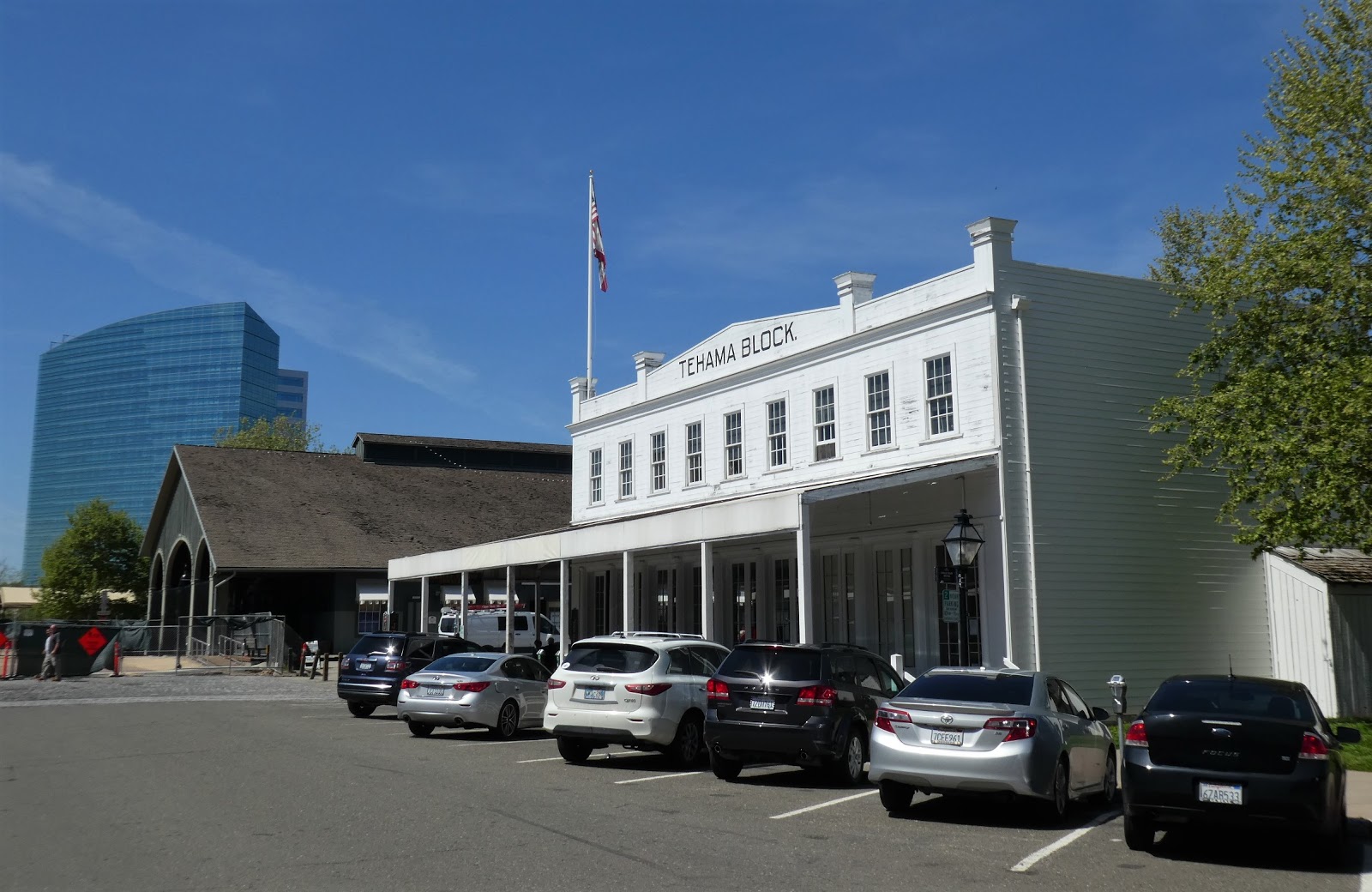
From my travel journal on 4-9-18: We flew to Sacramento from Seattle & arrived before 11 AM. We rented a car. We drove to Robert Matsui Waterfront Park. The causeway to the modern, architecturally striking water intake structure was closed, but we could see it clearly from the riverbank. The Sacramento River was high from heavy rain 3 days before. Trees along the riverbank were standing in water. We drove a short distance to Old Sacramento, also on the Sacramento River Waterfront. It was a very charming area filled with shops & restaurants in wooden 19th century buildings, older than any in Seattle. It had an "Old West" feel with covered sidewalks of wooden boards.

Old Sacramento State Historic Park is a National Historic Landmark District. The City of Sacramento began at Sutter's Fort, more than 2 miles from the Sacramento River & more than 1 mile from the place Sutter's party landed on the south bank of the American River & established a camp in 1839. The settlers moved to Sutter's Fort in 1841. In 1848, gold was found during the construction of  a sawmill on the American River. People rushed to find gold & the fort was largely deserted by 1850. When the Gold Rush began, local merchant Sam Brannan opened a store near the Sacramento River. First called Sutter’s Embarcadero, it soon became the City of Sacramento. The city grew rapidly as a center for outfitting miners.

Old Sacramento Historic District covers the area between the river & Interstate 5, I St & the Capitol Mall.  It is a relatively small district of 8 short streets from 2 to 4 blocks long. Almost all the buildings date from the mid-19th century, beginning after the fire of 1852. After varying amounts restoration, they look much like they originally did. While the architecture is Victorian, some buildings have characteristics such as large arched doorways, full-height balcony windows & wrought-iron balconies that show a Spanish influence. The buildings are filled with restaurants, gift shops & other tourist businesses.  While the shops can be a bit tacky, the facades of the buildings & the district a whole seem quite authentic. Old Sacramento State Historic Park attracts over 5 million visitors annually.

Friday, October 16, 2020

Midtown Sacramento


Photos taken in April 2018

Click here for more photos of Midtown Sacramento.

From my travel journal on 4-13-18: We went for dinner at Jack’s Urban Eats in Midtown, then walked around that area & had gelato. There were several gay businesses there, but it was also the main business district for all of Midtown Sacramento: a large, vibrant commercial & residential area. There were many beautiful Victorian houses, some used as offices. There were a few large new apartment buildings similar to those in Seattle. There was a light rail system. We liked it very much. 4-14-18: At 7 AM, I walked for a mile from the motel, through Midtown, to the commercial area where we had been the night before. I took lots of photos. Our motel was at the edge of Midtown, which covers about 2 square miles. There was a street market that morning. I bought bread.

Midtown is the most attractive, interesting & vibrant neighborhood in Sacramento. It is adjacent to & east of Downtown.  It lies between R St & J St, 16th St & 30th St.  Most of the neighborhood is residential. The Victorian, Queen Anne & Craftsman homes are charming & mostly well-maintained. Midtown is Sacramento's main area for restaurants, bars, clubs, boutiques, art galleries & various small businesses.  They cluster between 18th & 21st, N & J streets & also spread east along J St to 27th St. The Midtown Farmers Market takes place year-round, every Saturday, on 20th St between J St & L St in the center of this business district. Sacramento's small LGBTQ entertainment district & community center is located nearby at K St & 20th St.

Starting around 1890, Sacramento began to spread east from 16th St to Alhambra Blvd. The J St & K St business corridors were extended from downtown. This area of mixed housing & business was later called Midtown. Buffalo Brewing started in 1890 at 21st St & Q St, the largest brewery west of the Mississippi. Sutter's Fort was restored & rebuilt from 1891 to 1893. It was designated a National Historic Landmark in 1961. Firehouse No. 3 was built in 1893 at 1215 19th St & listed on the National Register of Historic Places in 1991. Memorial Auditorium opened in 1927 at 15th St & J St. California Packing Corporation (CalPak) Plant #11 began operations in 1930 at 17th St & C St. Sutter Memorial Hospital opened in 1937 as Sutter Maternity Hospital at 29th St & Capitol Ave.

The Capitol Mansions Historic District is located in Midtown between 22nd St & 27th St, Kayak Alley (between Capitol Ave & L St) & Matsui Alley (between Capitol Ave & N St). It is a group of more than 150 large, stately structures that were originally single-family residences. The features, characteristics & materials of the structures are consistent with Queen Anne & Classic Box/Foursquare homes. The latter is a sub-type of Colonial Revival homes, built prior to 1915. More than 150 structures were listed when Capitol Mansions became a historic district in 2004.

Friday, October 2, 2020

Sacramento Old City Cemetery


Photos taken in April 2018

From my travel journal on 4/14/18: We drove to the Old Sacramento City Cemetery, part of our tour of Sacramento. It was beautiful. I had never seen a cemetery with so many trees, shrubs & flowers. Lots of people were wandering around. There was a plant sale & a guided tour. Many gravestones were more than 100 years old. There was a special plot for governors of the State of California & other elected officials.

According to the City of Sacramento website: the Old City Cemetery is wonderful place to visit. It is an outdoor museum containing historical grave sites & statues, beautiful landscaping, roads & walking paths. I completely agree with this assessment. The City of Sacramento owns the 40-acre cemetery. It is the oldest existing cemetery in Sacramento, established in 1849 when Sacramento founder & planner John Augustus Sutter, Jr. donated the first 10 acres. Another 23 acres were donated by Sacramento legend Margaret Rhodes Crocker in 1880. In 1856, the first cemetery superintendent was hired & began to plan & landscape the grounds in the Victorian style of that era. Many sections are contained by brick or concrete retaining walls that create level terraces for planting. The cemetery was declared a State Historic Landmark in 1957 by the State Historical Landmarks Commission.

A Cemetery Master Plan was adopted by the Sacramento City Council in 2007. The rose garden was planted in the early 1990’s throughout the Cemetery. Each plot or gravesite is landscaped, most with various perennials & shrubs including roses, but some with only turf. 

In 2014, the cemetery was listed the in National Register of Historic Places, with significance designation at the state & local level as follows: “The site is eligible under Criterion B at the national level of significance for its association with cemetery benefactor Margaret Crocker and as the gravesite of multiple Sacramentans of transcendent importance for whom there is no other surviving property associated with their productive lives. The site is eligible at the state level of significance as an example of Victorian era "rational" cemetery planning, and as an assemblage of significant examples of funerary architecture, statuary and landscape design. It draws its significance from graves of persons of transcendent importance, age, distinctive design features, and association with historic events.”

Sacramento city code strictly protects the cemetery landscape: No person, except an authorized City Employee in the course and scope of his or her assigned duties, shall: (a) plant any tree, shrub, plant, or flower on the grounds of the City Cemetery without prior approval from the Cemetery Manager. This subsection does not prohibit the placement of cut, artificial, or potted flowers upon a grave; (b) cut, break, pluck, remove, or in any manner destroy or injure any tree, shrub, plant, or flower within the City Cemetery grounds without prior approval from the Cemetery Manager. This section does not prohibit the removal of weeds and dead vegetation by an authorized City employee, a person or business entity that has received approval as provided in paragraph (f) of this section, or an owner of a private plot, in the course of providing care and upkeep of plots.