Showing posts with label parks and public gardens beyond the Seattle area. Show all posts

Friday, October 2, 2020

Sacramento Old City Cemetery


Photos taken in April 2018

From my travel journal on 4/14/18: We drove to the Old Sacramento City Cemetery, part of our tour of Sacramento. It was beautiful. I had never seen a cemetery with so many trees, shrubs & flowers. Lots of people were wandering around. There was a plant sale & a guided tour. Many gravestones were more than 100 years old. There was a special plot for governors of the State of California & other elected officials.

According to the City of Sacramento website: the Old City Cemetery is wonderful place to visit. It is an outdoor museum containing historical grave sites & statues, beautiful landscaping, roads & walking paths. I completely agree with this assessment. The City of Sacramento owns the 40-acre cemetery. It is the oldest existing cemetery in Sacramento, established in 1849 when Sacramento founder & planner John Augustus Sutter, Jr. donated the first 10 acres. Another 23 acres were donated by Sacramento legend Margaret Rhodes Crocker in 1880. In 1856, the first cemetery superintendent was hired & began to plan & landscape the grounds in the Victorian style of that era. Many sections are contained by brick or concrete retaining walls that create level terraces for planting. The cemetery was declared a State Historic Landmark in 1957 by the State Historical Landmarks Commission.

A Cemetery Master Plan was adopted by the Sacramento City Council in 2007. The rose garden was planted in the early 1990’s throughout the Cemetery. Each plot or gravesite is landscaped, most with various perennials & shrubs including roses, but some with only turf. 

In 2014, the cemetery was listed the in National Register of Historic Places, with significance designation at the state & local level as follows: “The site is eligible under Criterion B at the national level of significance for its association with cemetery benefactor Margaret Crocker and as the gravesite of multiple Sacramentans of transcendent importance for whom there is no other surviving property associated with their productive lives. The site is eligible at the state level of significance as an example of Victorian era "rational" cemetery planning, and as an assemblage of significant examples of funerary architecture, statuary and landscape design. It draws its significance from graves of persons of transcendent importance, age, distinctive design features, and association with historic events.”

Sacramento city code strictly protects the cemetery landscape: No person, except an authorized City Employee in the course and scope of his or her assigned duties, shall: (a) plant any tree, shrub, plant, or flower on the grounds of the City Cemetery without prior approval from the Cemetery Manager. This subsection does not prohibit the placement of cut, artificial, or potted flowers upon a grave; (b) cut, break, pluck, remove, or in any manner destroy or injure any tree, shrub, plant, or flower within the City Cemetery grounds without prior approval from the Cemetery Manager. This section does not prohibit the removal of weeds and dead vegetation by an authorized City employee, a person or business entity that has received approval as provided in paragraph (f) of this section, or an owner of a private plot, in the course of providing care and upkeep of plots.

Friday, September 18, 2020

UC Davis Arboretum


Photos taken in April 2018

Click here for more photos of UC Davis Arboretum.

From my travel journal on 4/14/18: We drove to Davis, a city 17 miles west of Sacramento. We had Chinese food for lunch. There were many Chinese students from the University of California at Davis eating & working there. We drove around downtown Davis. It was lively, but not very charming. We went to the UC Davis Arboretum. It was very nice, covering 100 acres along the banks of Putah Creek, old north channel. Fortunately, it was mostly shaded, because it was sunny & warm that day.

Putah Creek flows 85 miles from the eastern slope of Cobb Mountain in the Coast Range to the Sacramento River. The name comes from Miwok people who lived near the creek. Puṭa wuwwe is said to mean grassy creek. Putah Creek flowed through the old north channel until it was redirected south in 1871.

The UC Davis Arboretum was founded in 1936. The arboretum’s collections include 22,000 trees & plants adapted to the local climate. The property is open to the public with walking & biking trails, picnic areas & wildlife viewing. The arboretum can be entered in many places. It is used for research by UC Davis faculty, students & others. It supports teaching at UC Davis with courses in many different disciplines using the arboretum. The arboretum has more than 20 different gardens featuring plants from California & countries with similar summer-dry climates across the globe. Visitors can learn about best practices in sustainable horticulture.

For thousands of years, this land has been the home of Patwin people, neighbors of the Miwok people. The Patwin people have remained committed to the stewardship of this land. The UC Davis campus is Patwin land & remains an important part of Patwin heritage & identity. The Native American Contemplative Garden recognizes this.

Friday, June 19, 2020

High Park Toronto

Black oak trees

Grenadier Pond

Ducks

Grenadier Pond

Hillside garden

Black oak savannah

Black oak savannah with birch trees. Photos taken in October 2017

On Monday October 23, I took the subway to High Park at 9 AM. It was beautiful. I walked across a vast lawn filled with large trees spaced at regular intervals, some with bright, falling leaves. Below that was a large pond filled with natural vegetation & ducks. There was a natural forest on the slope above the pond in an area called the West Ravine Nature Trails. People were walking & jogging along the paths. I walked back up to the slope through the Hillside Gardens. The Japanese garden along the creek was nice enough. But overall, I was not impressed with that area.  The giant maple leaf was tacky. There was a more impressive forest of black oak savannah at the top of the hill.  

That was that all I saw. There is much more to High Park. It is a big urban park covering 400 acres (161 hectares) & a perfect respite. It also has a swimming pool, playground, sports fields, cafe & zoo. High Park opened in 1876. The central section is a large plain that is mostly developed. But a significant portion is a rare, natural black oak savannah. Oak savannah is much more common in the US & Mexico. Black oaks (Quercus velutina) grow throughout High Park & many are more than 150 years old. Forested areas are maintained in a natural condition. The lovely Grenadier Pond covers 35-acres (14.2 hectares) on the western edge of the park. On a section of the hillside east of the pond, there are the various Hillside Gardens.  The giant maple leaf-shaped flower bed is visible from the top of the hill.  It looks better from a distance.

Friday, June 5, 2020

Village of Yorkville Park Toronto


Photos taken in October 2017

On Saturday October 21, we got breakfast from McDonald’s very near our hotel. We stayed near Bloor-Yonge subway station, a convenient place for public transportation, with many shops & restaurants. We walked to the Village of Yorkville Park where we ate our food. The park was very interesting, densely landscaped & divided into sections that followed the property lines of the original houses.  They had been replaced with a parking lot, later made into the park. It was a very pleasant place to rest.  Then we proceeded to the nearby Royal Ontario Museum.

The Village of Yorkville Park was completed in 1994.  By now, the plantings are fairly mature.  Groups of trees cast shade & beds are filled with perennials. Many of the plants are native to Canada & represent plant communities such as wetland, alder & birch groves.  There are 11 garden plots, each within the property lines of the row houses demolished in the 1950s. There is also open space & quite a lot of seating.  The busy design coalesces into a green, tranquil, yet diverse space.

The Village of Yorkville Park lies between the row houses of the old Yorkville neighborhood & the modern high-rises surrounding the intersection of Bloor & Yonge, near the subway station.  The park played an important role in revitalizing this area.  It remains a neighborhood landmark, a destination for residents & tourists alike, in the midst of a high-density residential & retail environment.

Friday, July 19, 2019

Jardin des plantes de Montpellier

Palms with the Tour des Pins in the background

Phlomis species (Jerusalem Sage)

Cycas revoluta (Sago Palm) & greenhouse

Prunus tomentosa (Nanking Cherry)

 Mahonia aquifolium (Oregon Grape)

Yucca rostrata


Photos taken in early March 2017

Click here for more photos of the Jardin des plantes de Montpellier.

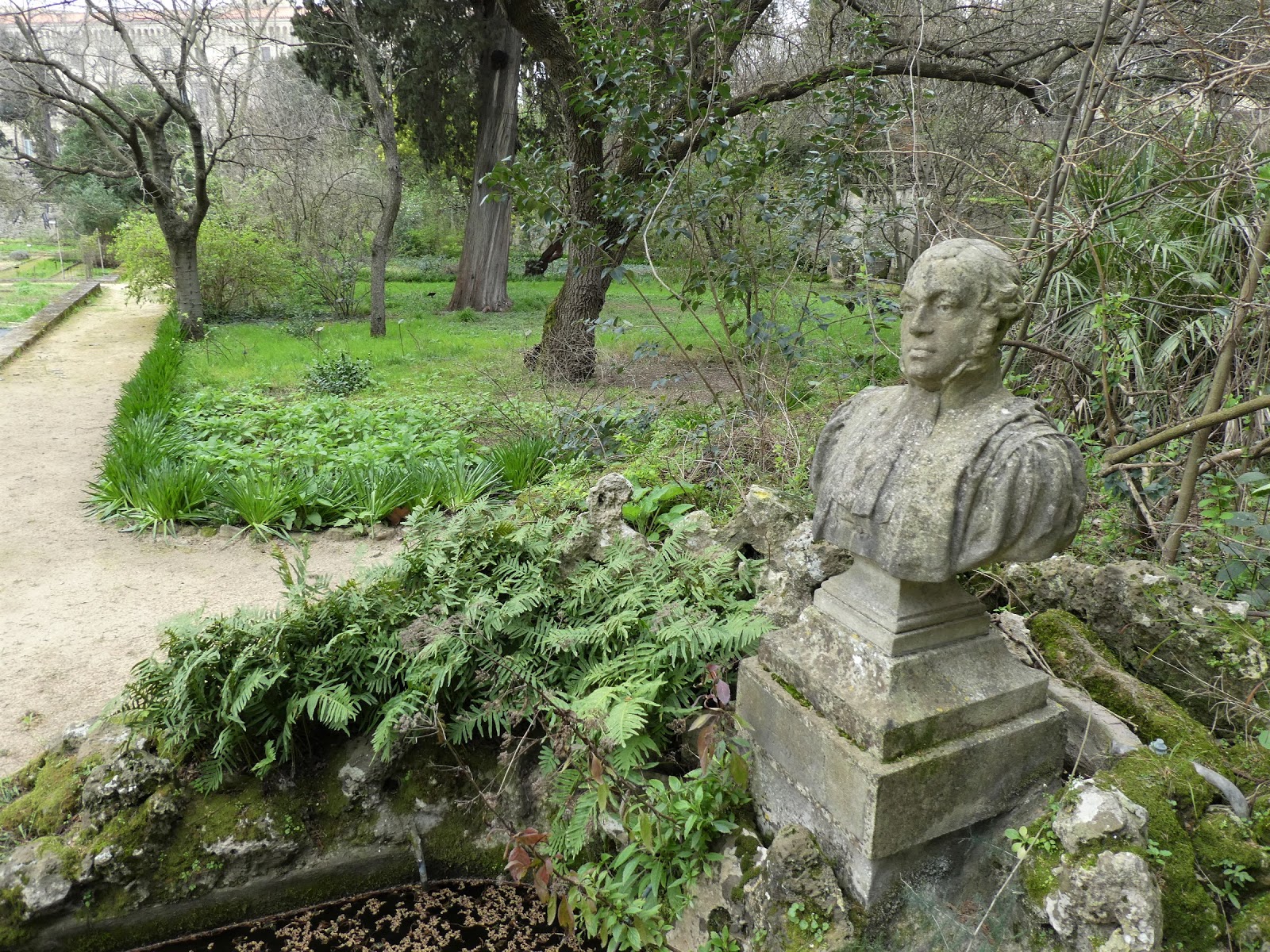
Montpellier became an important center for botany in the 16th century.  Botany was taught by the Faculty of Medicine at the University of Montpellier. At that time & long before it, most medicine came directly from plants & doctors needed extensive knowledge of medicinal botany.  The Royal Garden of Montpellier was created in 1593. It was ruined during the bombardment of Montpellier in 1622, then restored in 1629. It was opened to the public at end of the 18th century. The Jardin des plantes de Montpellier is the oldest botanical garden in France. It has remained university property since its creation.

The garden had significant development during the 19th century. The orangery was completed in 1804, the arboretum in 1810, the English Garden in 1859 & the greenhouse in 1860. The garden was named a protected nature preserve in 1982 & a national monument in 1992. The garden contains more than 2,500 plant species, including 500 native to the Mediterranean region. About 2,000 are grown outdoors & 1,000 under glass. The main collections include medicinal plants, the family Cistaceae (rockrose), arboretum trees, plus tropical & temperate plants in the greenhouse.

To be honest, I wasn't very impressed with the Jardin des plantes.  But I have seen many arboreta & botanical gardens, some of them excellent. The Jardin des plantes was interesting enough.  I was pleased to see a collection of plants from the western United States.  The garden is certainly worth a visit when you are in Montpellier. When I was there in March 2017, it wasn’t very well-maintained & many of the plants were still dormant. I’m sure it’s better in May. There were a number of gardeners working to clean it up.

Friday, May 17, 2019

Jardin botanique de Lyon


Veltheimia capensis

Helleborus liguricus

Primula x polyantha


Photos taken in March 2017

Click here for more photos of the Jardin botanique de Lyon.

The Jardin botanique de Lyon is an impressive botanical garden in the French city of Lyon.  It covers 20 acres, near the city center, in the much larger Parc de la Tête d'Or.  I walked there, but it is not far from a subway stop.  The garden has existed here since 1857, when the park was first established.  It is France's largest municipal botanical garden. It is said to have 15,000 plants, with 3,500 species from temperate regions.  There are also roses, peonies, alpine plants, water lilies & many plants in greenhouses.   The greenhouses cover 70,000 square feet.  The largest greenhouse is one of the most impressive of the many greenhouses I've seen.  But the beds of perennials & shrubs, laid out in concentric circles, was the most interesting part for me, as a gardener.  This botanical garden is a must for people who love plants & visit Lyon.

Friday, April 5, 2019

Jardin Exotique de Monaco


Photos taken in March 2017

Click here for more photos of Monaco.
Click here for a video of the view of Monaco from the Jardin Exotique.

The Jardin Exotique de Monaco is an extensive & densely planted succulent garden with excellent views of Monaco & the Mediterranean Sea.  This alone would be enough.  But in addition, there are two fascinating sites within the garden.  The first is a deep cave with guided tours.  The second is an engaging museum filled with artifacts found in the cave.  These items date back as far as the Neolithic Period.  There are bones of animals now extinct.  I used to live in the Los Angeles area & have seen many succulent gardens.  The plants here are the same as there: mostly cactus, Aloe, Euphorbia & Agave. Some are quite large.  The garden was dedicated in 1933.