Showing posts with label trees. Show all posts

Friday, September 4, 2020

Oak Grove Regional Park Stockton


Photos taken in April 2018

Click here for more photos of Oak Grove Regional Park.

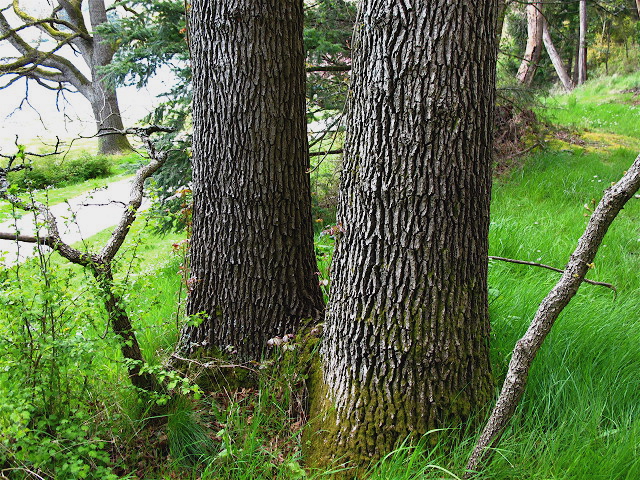
After breakfast at the motel in Sacramento, we drove to Oak Grove Regional Park in Stockton. We walked in the oak grove for almost 2 hours. There were dozens of large, old valley oaks (Quercus lobata). The trees were larger than any oak I’d seen in California before. The ground was covered with grasses & a few shrubs such as elderberry (Sambucus). We saw Canada geese, hawks & ground squirrels. Although there is housing development surrounding the park & infrastructure within the park, I didn't notice much but the oaks, the grass & the hawks high in the sky above.

Oak Grove Regional Park, between Stockton & Lodi (4520 West Eight Mile Road, Stockton) has an area of 180 acres. Two nature trails provide a 1.5 mile walk in the grove: the Yokuts Trail & the Miwok Trail. The shorter Yokuts Trail features native plants.  The much longer Miwok Trail winds through the oak grove. Oak Grove Nature Center focuses on wildlife, habitats & the native inhabitants of the area: the Miwok & Yokuts peoples. Oak Grove Regional Park is one of very few woodlands remaining in the California Central Valley.

Native Americans lived in the Central Valley for thousands of years before the town of Stockton was built. When Europeans arrived, they found the Yatchicumne, a group of Northern Valley Yokuts people, living in the Stockton area. The Yokuts built their villages on low mounds to avoid the regular flooding. A Yokuts village was located on a mound in what is now downtown Stockton. The number of Yokuts, whose settlements stretched 250 miles from the confluence of the Sacramento & San Joaquin rivers to the Tehachapi Mountains, is estimated at 18,000 to 50,000. They gathered acorns & ground Tule reeds into meal.  The reeds were also used to make baskets & mats that covered their dwellings. The Miwok inhabited lands to the north.  

The number of Native Americans in the San Joaquin Valley began to dwindle after their first contact the Spanish arrived in 1769.  Between 1805 & 1825, Franciscan priests persuaded many of them to move to the Santa Clara, San Jose, San Juan Batista & San Antonio missions. Those missions were mostly abandoned after an epidemic in 1833 killed 75% of the native population. During the Gold Rush of 1848, American settlers forced the remaining Yokuts from their lands.

The San Joaquin & Sacramento valleys join where the Sacramento & San Joaquin Rivers flow through Carquinez Strait to San Francisco Bay. Stockton lies at the southern edge of the the Sacramento Delta at the confluence of the San Joaquin & Calaveras Rivers. The Central Valley is an elongated depression (430 long & 75 miles wide) between the Coast Ranges & the Sierra Nevada. At its center, east of San Francisco Bay, it is slightly below sea level. The Central Valley is 2 joined valleys: the Sacramento Valley, drained by the Sacramento River & the San Joaquin Valley, drained by the San Joaquin River. The confluence of these two rivers forms the Sacramento-San Joaquin Delta, formerly a massive wetland, now a major agricultural area.

The Central Valley contained 3 primary communities of plants & animals: Valley Grassland, Freshwater Marsh, & Riparian Woodland. Woodlands grew in the Delta & along the rivers. In the mid-1800s, woodlands covered about a million acres of the Central Valley. Today they cover only about 100,000 acres. The disappearance of woodland is attributed to overgrazing by domestic animals beginning with cattle & sheep introduced by the Spanish & continued by American settlers.  Woodland trees include Western Sycamore (Platanus racemosa), Box Elder (Acer negundo) Fremont Cottonwood (Populus fremontii) & 3 species of willow. The most impressive tree is the Valley Oak (Quercus lobata).

Friday, February 6, 2015

Redwood in Lincoln Park

Redwood (Sequoia sempervirens) in Lincoln Park October 2011

Redwood (Sequoia sempervirens) in Lincoln Park October 2011

Redwood (Sequoia sempervirens) in Lincoln Park October 2011

Redwood (Sequoia sempervirens) in Lincoln Park October 2011

Redwood (Sequoia sempervirens) in Lincoln Park October 2011

If you have been thinking about planting Sequoia sempervirens (Coast Redwood) in Seattle, take a look at Lincoln Park in West Seattle.  There are at least 2 groves at the north end of the upper area of the park.  Redwoods are fairly common in Seattle parks, usually as single specimen trees.  It is unusual to find them in private gardens.  Oddly enough, it is more common to find Sequoiadendron giganteum (Sierra Redwood), a tree that takes up much more horizontal space, in private gardens here.  There is a 3rd redwood less commonly found in Seattle, the deciduous Metasequoia glyptostroboides (Dawn Redwood).  Sequoia sempervirens can live more than 1,500 years & grow to a height of more than 300 hundred feet.  They are unlikely to grow to that size in a garden environment, even if left alone for 1,500 years.  But don't plant them too close to the house.  Young trees grow quickly, a big plus for gardeners in a hurry.  The Sunset Western Garden Book says that Coast Redwood can be planted 7 feet apart.  But I would give them more space, maybe 10 feet apart at a minimum. Sequoia sempervirens are native to northern California from the Oregon border to the San Francisco Bay Area.

Friday, September 28, 2012

Sassafras in the Washington Park Arboretum

Sassafras albidum var. molle Washington Park Arboretum November 2011

Sassafras albidum var. molle Washington Park Arboretum November 2011

 Sassafras albidum var. molle Washington Park Arboretum November 2011

 Sassafras albidum var. molle Washington Park Arboretum November 2011

Sassafras albidum var. molle Washington Park Arboretum November 2011

Sassafras albidum var. molle Washington Park Arboretum November 2011

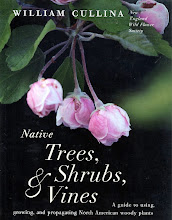
A friend took me to see Sassafras albidum at the Washington Park Arboretum.  I was glad because I had never seen Sassafras & didn't know where to look.  I was quite impressed by the beauty of the foliage & the thicket of canes.  My friend pointed out that the leaves come in 4 shapes: 1 lobe, 2 lobes (both right-hand & left-hand mittens) & 3 lobes. I realized I had seen the leaves before when they were brought to a garden group meeting.  Gabriel Rochard wrote, 'One of my favourites. I've discovered it in a nursery in France, a great Lauraceae and beautiful in Fall.'  In Native Trees, Shrubs & Vines, William Calluna writes, 'While you need to take a certain rambunctiousness into account with sassafras, in the right situation, like the boundary between lawn & field or field & forest, it is interesting in carriage, flower & leaf, & I highly recommend it.'  In the city, I can see sassafras between properties, or at the boundary between lawn & alley.  I would fear to let it loose in our Northwest forests.  Calluna also writes, 'I have had some trees in my yard that grew contentedly as a single trunk, while others were readily thicket forming.'  As a medium tree with a single trunk, it would be appropriate almost anywhere.

From the US Forest Service: Sassafras albidum is common on abandoned farmlands throughout its range. Sassafras is a common component of bear oak (Quercus ilicifolia) scrub on dry sites along the Coastal Plain. In dry pine-oak forests, sassafras sprouts prolifically & is a dominant shrub producing extensive thickets where few other woody plants can establish. In the northern parts of its range, sassafras occurs in the understory of open stands of aspen & in northern pin oak (Quercus ellipsoidalis) stands. On poor sites, particularly in the Appalachian Mountains, sassafras is frequently associated with black locust (Robinia pseudoacacia) & amp; sourwood (Oxydendron arboreum). In old fields with deep soils, sassafras commonly grows with elms, ashes, Acer saccharum & Liriodendron tulipifera.

Friday, August 24, 2012

Hickory in the Washington Park Arboretum

Carya ovata Washington Park Arboretum October 2011

Carya ovata Washington Park Arboretum October 2011

Carya ovata Washington Park Arboretum October 2011
 
Carya ovata Washington Park Arboretum October 2011

I knew nothing about Shagbark Hickory, or Hickories in general, until I came across this small grove in the Washington Park Arboretum.  But that is a wonderful thing about the arboretum.  Any day you look at tags on trees & shrubs, you learn something new.  I photograph the tags, as well as other parts of the plants.  But you could also take a notebook & pencil.  I found Carya ovata quite attractive in bark, form & foliage.  You can find them between Azalea Way & Lake Washington Boulevard, near the ponds.

From Wikipedia:
Carya ovata, the Shagbark Hickory, is common in the eastern US and SE Canada. It is a large deciduous tree growing up to 27 m tall, and will live up to 200 years. Mature Shagbarks are easy to recognize because they have shaggy bark. The nuts are edible with an excellent flavor & can be used as a substitute for Pecan (Carya illinoensis). The genus Carya includes 17–19 species: 5-6 species in Asia, 19-20 in North America. Hickory wood is used for smoking cured meats. Hickory is popular for barbecue in the SE US as Hickory grows abundantly in the region, and adds flavor to the meat. The nuts of some species are palatable, while others are bitter and only suitable for animal feed. Shagbark and Shellbark Hickory, along with Pecan, are regarded by some as the finest nut trees.

Friday, July 27, 2012

Pinus kwangtungensis

Pinus kwangtungensis in the Cascadia Garden October 2011

Pinus kwangtungensis at Washington Park Arboretum November 2011

Pinus kwangtungensis at Washington Park Arboretum November 2011

Pinus kwangtungensis at Washington Park Arboretum November 2011

Pinus kwangtungensis cones from the Cascadia Garden

Kwangtung Pine is a beautiful tree.  I'm completely enchanted by the specimen I got from Terra Nursery (in Redmond, WA) at a Northwest Horticultural Society plant sale in 2006.  It has been popular with tourists at the Cascadia Garden, always receiving positive comments.  The blue-green color is excellent.  Both new & old cones are attractive.  It has taken well to life in a large pot.  I was excited to recognize the tree at the Washington Park Arboretum, along the east side of the East Drive near the Pacific Rim Garden, in November of 2011.  It has a very fine, slender form.  I would certainly plant it, if there were enough space.  In fact, I'd plant a grove.  According to the South China Botanical Garden, Guangzhou, Guangdong Province, P. R. China: Pinus kwangtungensis is a vulnerable species in China. It has often been confused, and even united, with Pinus fenzeliana; however, the two species are not considered here to be conspecific. It is found on hills, slopes, mountain ridges, summits at 500-1600 meters in N Guangdong, SW Guangxi, S Guizhou, Hainan, S Hunan & Vietnam.

Tuesday, July 3, 2012

Cork Oak in the Washington Park Arboretum

Quercus suber in the Washington Park Arboretum November 2011

 Quercus suber in the Washington Park Arboretum November 2011

 Quercus suber in the Washington Park Arboretum November 2011

Quercus suber in the Washington Park Arboretum November 2011

I don't often see Quercus suber in Seattle.  There is this tree in the Washington Park Arboretum, just east of the East Drive, not far north of the Pacific Rim Garden.  There is another Downtown on 2nd Avenue & others in the comma at the north end of Hunter Boulevard S near my home.   I think there are not enough specimens to determine whether Cork Oak is a good choice for Seattle.  But it would certainly be worth trying on a dry & sunny site.

This information from Wikipedia:
Quercus suber has a thick bark that protects it against fire. After a fire, many other tree species regenerate from seeds, or resprout from the base of the tree.  Cork Oak branches quickly resprout & recompose the tree canopy. Over time the cork layer of bark becomes quite thick.  It can be harvested every 9 to 12 years. The harvesting of cork does not harm the tree. After cork is removed, a new layer regrows. The tree is cultivated in Portugal, Spain, France, Italy, Morocco, Algeria & Tunisia. Cork Oak forests cover approximately 25,000 square kilometers in those countries. In Portugal & Spain, Cork Oak forests are home to the Iberian Lynx, the most critically threatened feline in the world. Portugal accounts for half of the world cork harvest. Cork Oaks cannot legally be cut down in Portugal, except for the felling of old, unproductive trees, with special permission from the Ministry of Agriculture. Cork Oaks can live to 250 years. Cork harvesting is done entirely without machinery. It is harvested with small axes. This process requires training due to the skill required to harvest cork without harming the tree.

Friday, November 18, 2011

Madrona in Seward Park

 Arbutus menziesii in Seward Park May 2011

 Arbutus menziesii in Seward Park March 2011

 Arbutus menziesii in Seward Park March 2011

  Arbutus menziesii in Seward Park March 2011

 Arbutus menziesii in Seward Park October 2011

 Arbutus menziesii in Seward Park October 2011

 Arbutus menziesii in Seward Park October 2011

There are many places in Seattle to see Arbutus menziesii (Madrona).  Seward Park is one of the best sites.  The largest number congregate on the south slope of the peninsula.  Arbutus menziesii is found on the west coast of North America, from British Columbia to California.  In California it is know as Madrone.  Madrona & Madrone are derived from the Spanish word madroño, which is the common name for Arbutus unedo (Strawberry Tree) in that country.  Arbutus menziesii was named for the Scottish naturalist Archibald Menzies, who took note of it while sailing in the area with Captain George Vancouver from 1792 to 1795.  They circumnavigated Vancouver Island & explored Puget Sound, where the tree is widely distributed.  It is restricted to dry & well-drained sites, usually south or west-facing slopes.  It is a major component of Douglas Fir /Tanoak/Madrona (Pseudotsuga menziesii/Lithocarpus densiflorus/Arbutus menziesii) forests characterized by an overstory of Douglas Fir with Tanoak & Madrona sharing the secondary canopy in varying proportions. Madrona also mixes with Western Hemlock (Tsuga heterophylla) & Garry Oak (Quercus garryana).  It surrounds the grove of Garry Oak in Seward ParkArbutus menziesii is a broad-leaved, evergreen tree of up to 130 feet in height. Single or multiple curved trunks support a broad, spreading crown composed of heavy, irregularly-shaped limbs. The bark peels off in tightly curled strips. Once the outer bark is shed, the remaining bark has a smooth, polished appearance. The color of the new bark is pale green but darkens to orange with age. Older portions of the bark become brown & fissured. The urn-shaped flowers are borne in showy, terminal clusters. The fruit is a pea-sized berry consisting of mealy pulp and numerous seeds.  Madrona is a member of the family Ericaceae.  The bark & flowers are similar to Arctostaphylos (Manzanita) another Ericaceae family member.

Friday, November 4, 2011

Garry Oak in Seward Park

Quercus garryana in Seward Park June 2011

Quercus garryana in Seward Park June 2011  

Quercus garryana in Seward Park May 2011

 Quercus garryana in Seward Park March 2011

 Quercus garryana in Seward Park October 2011

Quercus garryana in Seward Park October 2011

Seward Park contains the remnants of an oak prairie that grew along the shore of Lake Washington, a small grove of Quercus garryana (Garry Oak) which includes 2 very large trees.  Garry Oak can also be found in nearby Martha Washington Park.  These trees may have been planted by the Duwamish people as a source of acorns for food.  In Seward Park, the grove can be found on the south shore of the peninsula, not far from the eastern end of the parking lot.  Garry Oak occurs from Vancouver Island to southern California. It is found mostly west of the Cascade Range but a few populations are scattered to the east. Garry Oak habitat loss is extensive. Garry Oak woodlands and savannahs in the Willamette Valley have declined to less than 15% of their extent before European settlement. In British Columbia habitat loss exceeds 95%. Habitat loss is a result of fire suppression, altered land use, introduced non-native species & heavy grazing. Quercus garryana can reach 100 feet tall with a single trunk, or 20 feet tall with many trunks. The trunks have thick, furrowed, scaly bark. Leaves are moderately to deeply lobed and measure up to 6 inches long with 3 to 7 pinnate lobes. Garry Oak produces large acorns that measure 0.8 to 1.2 inches (2-3 cm) long and mature in a single growing season. Five hundred years is the estimated lifespan. Quercus garryana is also known at Oregon White Oak.

Friday, August 12, 2011

Trees

Cupressus sempervirens April 2011

Malus (Crabapple) April 2011

Arbutus menziesii in Seward Park April 2011

Magnolia x soulangeana March 2010

 Ginkgo biloba September 2010

Here is a list of trees for gardens in Seattle, the Pacific Northwest & USDA Zone 8. Many will tolerate colder climates.  They have good form, lovely flowers, colorful fall foliage & other characteristics that endear them to many gardeners. Most of these are deciduous.  Evergreen trees are noted.  Some may be difficult to find. When local nurseries fail, try mail-order nurseries.  Forest Farm is a good source for uncommon trees.  This list is not meant to provide detailed information on trees, but to introduce you to some you may not know, or remind you of those you have forgotten.  Basic characteristics are included to help you sort through the lists.  Be sure you know how widely these trees spread before you plant them, to allow enough space.  Narrow trees are listed separately here.  An abundance of detailed information is available on the web.  Good reference books on shrubs are The Hillier Gardener's Guide to Trees & Shrubs edited by John Kelly, Sunset Western Garden Book

Small Trees
Abies koreana (Korean Fir) Abies pinsapo (Spanish Fir): evergreen
Acer buergerianum (Trident Maple) Acer campestre (Hedge Maple) Acer circinatum (Vine Maple) Acer crataegifolium (Hawthorne Maple) Acer japonicum (Fullmoon Maple) Acer maximowiczianum (Nikko Maple) Acer palmatum (Japanese Maple) Acer pennsylvanicum (Moosewood): fall color
Aesculus pavia (Red Buckeye): flowers
Amelanchier alnifolia (Western Serviceberry) Amelanchier canadensis (Eastern Serviceberry) Amelanchier x grandiflora, Amelanchier laevis (Allegheny Serviceberry): flowers, fruit, fall color
Arbutus unedo (Strawberry Tree): evergreen, flowers, fruit can make a mess on pavement
Azara microphylla (Boxleaf Azara): evergreen, small flowers, narrow
Cercis canadensis 'Forest Pansy' (Eastern Redbud): purple leaves, flowers, fall color, Cercis siliquastrum (Judas Tree): flowers, fall color
Chamaecyparis pisifera ‘Boulevard’ (Boulevard Cypress): evergreen, slow growth
Cladrastis lutea (Yellow Wood): flowers, fall color
Cornus kousa (Korean Dogwood) Cornus mas (Cornelian Cherry): flowers, fruit
Crataegus laciniata, Crataegus laevigata ‘Rosea Flore Pleno’ (English Hawthorn) Crataegus phaenopyrum (Washington Hawthorn) Crataegus prunifolia: flowers, fruit, fall color
Cupressus arizonica var. glabra ‘Blue Ice’ (Arizona Cypress): evergreen
Franklinia alatamaha (Franklin Tree): flowers, fall color
Genista aetnensis (Mt Aetna Broom): flowers
Hamamelis x intermedia, Hamamelis mollis (Witch Hazel): fragrant flowers, fall foliage
Malus ‘Adams’, Malus ‘Dartmouth’, Malus ‘Katherine’, Malus ‘Thunderchild’ (Crabapple): & many other cultivars, flowers, fruit can make a mess on pavement
Oxydendron arboreum (Sourwood): flowers, fall color
Parrotia persica (Parrotia): fall color
Pinus cembra (Swiss Stone Pine) Pinus edulus (Pinyon Pine): evergreen
Podocarpus macrophyllus (Yew Pine): evergreen, not a pine
Prunus cerasifera ‘Thundercloud’ (Flowering Plum) Prunus mume (Japanese apricot) Prunus serrula, Prunus serrulata (Flowering Cherry): flowers
Pyrus calleryana ‘Bradford’ (Bradford Pear): flowers, fall color, Pyrus salicifolia 'Pendula' (Weeping Willow-leafed Pear): flowers, silver foliage, weeping form
Quercus gambelii (Gambel Oak): tolerates dryness
Rhus typhina (Staghorn Sumac): fall color
Sorbus cashmiriana (Kashmir Mountain Ash) Sorbus commixta (Japanese Mountain Ash) Sorbus hupehensis (Hupei Mountain Ash) Sorbus scalaris: flowers, fruit, fall foliage
Styrax japonica (Japanese Snowbell) Styrax obassia (Fragrant Snowbell): flowers
Taxus cuspidata (Japanese Yew): evergreen
Thuja standishii (Japanese Arborvitae): evergreen
Thujopsis dolabrata (False Arborvitae): evergreen
Trachycarpus fortunei (Chinese Windmill Palm): evergreen, the only reliable palm in Seattle
Ulmus japonica (Japanese Elm): fall color

Medium Trees
Abies amabilis (Cascade Fir): evergreen
Acer callipes, Acer davidii, Acer griseum (Paperbark Maple): fall color, interesting bark
Aesculus californica (California Buckeye) Aesculus x carnea (Red Horse Chestnut): flowers
Albizia julibrissin (Mimosa): flowers
Betula albo-sinensis (Chinese Red Birch) Betula jacquemontii (Himalayan Birch) Betula papyrifera (Paper Birch) Betula pendula (Silver Birch): fall color, beautiful bark, birches attract aphids which drip sticky excretions on patio furniture & cars
Carpinus caroliniana (American Hornbeam): fall color
Catalpa bignonioides (Southern Catalpa): flowers, pods
Cercidiphyllum japonicum (Katsura Tree): fall color
Chamaecyparis lawsoniana ‘Pembury Blue’ (Port Orford Cedar) Chamaecyparis nootkatensis ‘Pendula’ (Weeping Alaskan Cedar) Chamaecyparis obtusa ‘Gracilis’ (Slender Hinoki Cypress): evergreen
Crataegus mollis (Downy Hawthorne): flowers, fruit, fall color
Davidia involucrata (Dove Tree): flowers, fruit
Gymnocladus dioica (Kentucky Coffee Tree)
Idesia polycarpa (Idesia): inedible berries
Magnolia macrophylla (Bigleaf Magnolia): flowers, huge leaves
Nothofagus antarctica (Southern Beech): fall color
Nyssa sylvatica (Black Gum): fall color
Pawlonia tomentosa (Empress Tree): flowers, large leaves
Picea breweriana (Brewer Spruce): evergreen
Pinus contorta var. contorta (Shore Pine) Pinus leucodermis (Bosnian Pine) Pinus pinea (Italian Stone Pine) Pinus monticola (Western White Pine): evergreen
Quercus chrysolepis (Canyon Live Oak): evergreen, Quercus garryana (Garry Oak): shade tolerant
Robinia pseudoacacia ‘Frisia’ (Golden Locust): yellow foliage
Sciodopitys verticillata (Umbrella Pine): evergreen, not a pine
Sorbus alnifolia (Korean Mountain Ash) Sorbus aria (Whitebeam): flowers, fruit, fall color
Stewartia pseudocamellia (Japanese Stewartia): flowers, fall color
Taxus brevifolia (Pacific Yew): evergreen, fruit
Tilia americana (American Linden) Tilia cordata (Littleleaf Linden): fall color

Large Trees
Abies concolor (White Fir) Abies grandis (Giant Fir) Abies procera (Noble Fir): evergreen
Acer macrophyllum (Bigleaf Maple) Acer platanoides (Norway Maple): fall color
Aesculus hippocastanum (Horse Chestnut): flowers, big leaves, fall color
Araucaria araucana (Monkey Puzzle): evergreen, unique appearance, historic in Seattle
Arbutus menziesii (Madrona): evergreen, flowers, fruit, lovely bark, native in Seattle
Calocedrus decurrens (California Incense Cedar): evergreen, narrow
Carpinus betulus (European Hornbeam): fall color
Catalpa speciosa (Western Catalpa): flowers, pods
Cedrus atlantica (Atlas Cedar) Cedrus deodara (Deodar Cedar): both are common in Seattle, Cedrus libani (Cedar of Lebanon): evergreen
Cupressus sempervirens (Italian Cypress): evergreen, narrow
Fagus grandifolia (American Beech) Fagus sylvatica (European Beach): fall color
Fraxinus americana (White Ash) Fraxinus latifolia (Oregon Ash): fall color
Ginkgo biloba (Ginkgo): fall color, unique appearance
Gleditsia triacanthos (Honey Locust): pods, fall color
Larix decidua (European Larch) Larix kaempferi (Japanese Larch) Larix occidentalis (Tamarack): deciduous conifer, fall color
Liquidambar styraciflua (Sweetgum): fall color
Liriodendron tulipifera (Tulip Tree): flowers, fall color, very large distiguished tree
Magnolia grandiflora (Southern Magnolia): evergreen
Metasequoia glyptostroboides (Dawn Redwood): deciduous conifer, fall color, 'living fossil'
Picea abies (Norway Spruce) Picea oromika (Serbian Spruce) Picea sitchensis (Sitka Spruce): evergreen
Pinus densiflora (Japanese Red Pine) Pinus ponderosa (Ponderosa Pine) Pinus thunbergii (Japanese Black Pine): evergreen
Platanus x acerifolia (London Plane Tree) Platanus occidentalis (American Sycamore)
Platanus racemosa (California Sycamore): large leaves, beautiful bark
Pseudotsuga menziesii (Douglas Fir): evergreen, native in Seattle
Quercus coccinia (Scarlet Oak) Quercus lobata (Valley Oak) Quercus robur (English Oak) Quercus rubra (Red Oak)
Sequoia sempervirens (Coast Redwood): evergreen
Sequoiadendron giganteum (Sierra Redwood): evergreen, impressive
Stewartia monadelpha (Tall Stewartia): flowers, beautiful bark, fall color
Thuja plicata (Western Red Cedar): evergreen, sacred tree, native to Seattle
Tilia tomentosa (Silver Linden): fall color
Tsuga heterophylla (Western Hemlock): evergreen, native in Seattle

Narrow Trees
Acer circinatum (Vine Maple): fall color, native in Seattle
Azara microphylla (Boxleaf Azara): evergreen, small flowers
Calocedrus decurrens (California Incense Cedar): evergreen, narrow
Chamaecyparis lawsoniana ‘Ellwoodii’ (Port Offord Cedar): evergreen, formal
Ginkgo biloba ‘Tremonia’ (Ginkgo): fall color
Juniperus communis ‘Hibernica’ (Irish Juniper): evergreen, formal
Pinus ponderosa (Ponderosa Pine)
Prunus serrulata ‘Amanogawa’ (Flowering Cherry): flowers, fall color
Pyrus calleryana ‘Chanticleer’ (Chanticleer Pear): fall color
Quercus robur 'Fastigiata' (English Oak): fall color
Thuja plicata ‘Fastigiata’ (Hogan Cedar): evergreen
Thujopsis dolabrata (False Arborvitae): evergreen
Trachycarpus fortunei (Chinese Windmill Palm): evergreen,  the only reliable palm in Seattle