Showing posts with label perennials. Show all posts

Friday, February 7, 2020

Helleborus foetidus


Photos above taken in January 2018


Photos above taken in March 2018.  All photos are from my garden.

Helleborus foetidus (Stinking Hellebore) has worked exceptionally well in my dry, lightly shaded garden in Seattle.  There is moderate to fairly steep slope, so the plants are never in standing water.  A 50-foot tall Fraxinus oregana (Oregon Ash) extends sparse branches, 20 feet above ground level, over the area.  My 15 hellebores, scattered randomly, make quite a show from January through March.  The foliage is attractive all year.  The plant is called the stinking hellebore, because of the odor of its crushed leaves.  I've never noticed the odor.  It's a needlessly off-putting name.  I took seedlings no more than 5 inches tall from another garden where they were plentiful.  Those seedlings grew to their mature height (2 to 3 feet) within 3 years.  The plants continue to expand laterally as the number of stalks increase.  This is a long-lived perennial.  The stalks die after blooming & setting seed.  New stalks grow to replace them & bloom the next year.  The green or chartreuse flowers are attractive to insects, especially bees.  The leaves are dark green, but leaves, stalks & flowers are sometimes tinted red. The Wester Flisk Group of Helleborus foetidus is reliably reddish.  I suppose that my plants may be descendants of that group.  Helleborus foetidus is native to the mountainous regions of Central and Southern Europe, Greece & Turkey.

Friday, July 21, 2017

Clematis integrifolia


Clematis integrifolia 'Hanajima'

Clematis integrifolia is a flowering perennial for sun.  It blooms from early to mid-summer in Seattle.  The word Clematis is taken from the Greek word for climbing plants.  Integrifolia means entire-leaf.  Botanically speaking, an entire leaf has a smooth edge, is not toothed.  This Clematis is not a vine.  It has stems of maybe 18 inches long that don't cling.  The stems are floppy & will cascade over a low wall, lie flat on the ground, or prop themselves against other plants.  Each stem bears several flowers.  The number of stems increase as the plant matures.  The usual flower color is blue, but 'Hanajima' is pink.  Flowers are simple & charming, each with 4 petals.  The plant is not drought tolerant, but doesn't need a lot of water.  Plant them among other perennials, but don't allow them to become shaded. Clematis integrifolia is native to Italy, the Balkans, Eastern Europe, the Caucasus, Siberia & Central Asia.

Tuesday, June 20, 2017

Erigeron glaucus


Erigeron glaucus is a very flowerful & easy plant to grow in dry sun.  It blooms continuously through the summer, with the largest number of flowers coming in June.  Bloom can start in April & end in October.  Bees love it.  The normal flower color is blue-lavender.  'Sea Breeze' has pink flowers & seems to be the form most commonly sold in Seattle.  The plant is low & spreading, not more than one foot high & up to 3 feet wide.  It looks nice cascading over rocks & walls.  It is drought tolerant, but can't do entirely without water during the summer.  Water regularly, but not heavily, or more than once a week.  The stems of this plant & sometimes also the leaves survive the winter.  Don't cut it back to the base, just remove the obviously dead parts, mostly the flower heads.  It is native to the California & Oregon coasts, where it grows on bluffs, sand dunes & beaches.

Friday, May 19, 2017

Brunnera macrophylla 'Jack Frost'


Brunnera macrophylla 'Jack Frost' is a very attractive perennial for shade.  The heart-shaped leaves are mostly a silvery-white, but with green veins.  It's eye-catching.  I think it's not gaudy, but probably too bright for some.  The small, bright-blue flowers come in May.  They are pretty, but bloom is usually not very dense.  The plant forms a mound about 2 feet wide fairly quickly, but does not seem to exceed that.  When in flower, it reaches 2 feet tall.  It disappears in winter.  Brunnera macrophylla is native to the Caucasus, Georgia & Turkey in forests & on grassy slopes.  The common name is Siberian Bugloss.  Brunnera macrophylla is better in part shade than deep shade.  It needs moderate water in summer & tolerates some wetness in winter.  Use it in a shaded perennial border, or between shrubs under trees.

Friday, April 21, 2017

Geranium phaeum


Geranium phaeum makes a great background plant & filler of space in lightly shaded areas.  It is fairly tolerant of dryness.  It's a pretty plant with a profusion of dark blue, purple or black flowers in April & May.  Black flowers suggest the common name Mourning Widow.  Geranium phaeum is taller than most  species.  It grows to a height of nearly 2 feet when in flower.  The flower spikes with seed pods are also attractive.  There is no need to cut them back after bloom has faded.  The leaves are pleasing in form.  Some have nice purple blotches, like the cultivar 'Samobor'.  Geranium phaeum is native to Europe in the Pyrenees & Alps in subalpine meadows & forests.  This is a good candidate for dry, light shade.  

Tuesday, September 20, 2016

Helenium autumnale


Helenium autumnale

Helenium autumnale is a flowering perennial plant for sun.  It generally blooms in September & October.  The common name is common sneezeweed & it is commonly available at most nurseries during the later part of summer.  It is also called Helen's flower.  The name genus name Helenium comes from the Greek word for another plant named for Helen of Troy & autumnale means 'pertaining to autumn'.  Helenium autumnale is native to North America where it is widespread across the US & Canada.  The only state where it has not been found to grow is New Hampshire.  I'm not sure they have looked hard enough in that state.  The flowers are yellow, orange, brick red, or a combination of those colors.  Helenium autumnale grows to about 3 feet tall & requires a moderate amount of water.  It also tolerates wetness.  It is not the most beautiful of plants, but the flowers are pretty & the colors bold.  It blooms at a time when there is little else.

Tuesday, July 19, 2016

Acanthus hungaricus


Acanthus hungaricus

Acanthus hungaricus is a fairly common species of Acanthus in Seattle.  It is more tolerant of dryness than Acanthus mollis, which is much more common.  Acanthus hungaricus has beautiful, holly-like foliage that is not at all spiny.  Flowers come in midsummer, with purple bracts forming hoods over white corollas, which line the stems in many tiers to present quite an impressive display of flowers.  The stems may reach 4 feet in height, but more usually 3 feet.  This plant spreads continually, but not very aggressively & will need to be divided when it begins to crowd its neighbors.  Acanthus hungaricus is a perennial plant for full sun in well drained soil.  It is native to Europe in Romania, the Balkans & Greece.  The common name for Acanthus is bear's breeches, in this case Hungarian bear's breeches.  I hear it called Acanthus more often.

Friday, June 17, 2016

Euphorbia nicaeensis


Euphorbia nicaeensis


Euphorbia nicaeensis with Stachys byzantina (Lamb's Ears)

Euphorbia nicaeensis is a perennial plant, evergreen in Seattle, with new stems in spring reaching two feet in length & replacing the stems of the previous year, which wither during the summer, as in many other Euphorbia species.  It blooms in June.  The plant is easy to grow, requires very little water & good drainage.  It is a good candidate for a Mediterranean garden & really quite lovely.  Euphorbia nicaeensis is similar in size & shape to Euphorbia rigida, another worthwhile & more common species.  Euphorbia nicaeensis is a bit difficult to find.  I ordered mine from Joy Creek Nursery in Scappoose, Oregon. Euphorbia nicaeensis is native to Europe in Portugal, Spain, France, Italy & Croatia, as well as Turkey & the Caucasus.  Nicaea was an ancient city which now lies within the modern Turkish city of Iznik.  Nicaea Maritima was the ancient Roman name for the city of Nice, France.  The specific epithet 'nicaeensis' (of Nicaea) can refer to either city, both within the range of this plant.  It was likely observed by the participants of the Council of Nicaea in the year 325, which may be significant to those interested in early Christian history.

Monday, April 18, 2016

Dicentra formosa

Dicentra formosa (Native Bleeding Heart)

Dicentra formosa is a perennial forest plant native to the Northwest Coast, from the Pacific Ocean to the Cascade Mountains in Washington & Oregon.  It is one of our most beautiful native plants.  The flowers are usually a pale pink, but darker individuals, like the one shown in this photo, can be found. In time, one plant will spread widely by its creeping rootstock & also by seed.  Over several years it may fill up a shaded area.  Dicentra formosa does not grow well in full sun, but will take some partly sunny locations.  This is primarily a plant of the forest floor with moderate water needs in summer.  The leaves have a pleasing, fern-like appearance.  They die to the ground in winter.  Dicentra formosa pairs nicely with Oxalis oregana, a native forest groundcover.  Find them in the native plant section of most nurseries in the Seattle area.

Friday, June 10, 2011

Allium in the Cascadia Garden

Allium 'Globemaster' May 2009

Allium karataviense May 2010

Allium cernuum June 2009

Allium cristophii June 2010

 Allium unifolium June 2009

I love Allium in my garden in Seattle.  I got my 1st Allium bulbs in 1995 from John Scheepers, Inc.  They were Allium karataviense & Allium neapolitanum.  The Allium neapolitanum soon became a thick mass of foliage with no blooms.  Allium karativiense slowly spread through the garden, with & without my help.  It has beautiful foliage & pretty flowers.  Allium foliage tends to dry up as the flowers begin to open.  Next up was Allium christophii, which remains my favorite.  The flowers heads are huge, the color stunning.  Then came the impressive Allium 'Globemaster' with large, dense flower heads on tall stems.  Nectaroscordum siculum is an interesting Allium relative with large, nodding bells.  The other Allium I like, but don't love.  I can see that Allium cernuum would easily spread to every sunny inch of the garden.  Now I cut off the small flower heads before they set seed.  I've included the bloom times I've observed in my garden. Allium require no care & very little water.

List of Allium in the Cascadia Garden (with bloom times)
Allium aflatunense 5-08-10, 5-18-09, 5-18-08
Allium cernuum  6-12-09
Allium cristophii 5-16-10, 5-26-09, 5-25-08
Allium ‘Globemaster’ 5-04-10, 5-18-09, 5-18-08
Allium karataviense 5-01-10, 5-09-09, 5-10-08
Allium neapolitanum
Allium nigrum
Allium schubertii 5-22-10, 5-23-09, 5-25-08
Allium senescens 9-05-10, 9-12-08
Allium taquetii  7-02-08
Allium unifolium 5-27-10, 5-30-09, 5-25-08
Nectaroscordum siculum (formerly Allium bulgaricum) 5-07-10, 5-20-09, 5-22-08

Friday, May 27, 2011

Perennials for Sun

 
Zauschneria latifolia July 2010

Paeonia veitchii May 2010

Kniphofia nelsonii June 2009

Lilium 'White Henryi' July 2010

 Sedum 'Matrona' August 2008

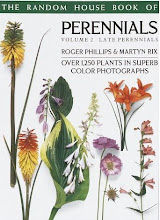
Here is a list of sun-loving perennials for gardens in Seattle, the Pacific Northwest & USDA Zone 8.  It includes xeric perennials (those that like dry conditions) & perennials for moist sites.  Most of these plants are fairly common in the temperate gardens of North America & Europe. None are difficult to grow.  A perennial is any plant, not woody, that lives for at least a few years, although some are short-lived.  Perennials include bulbs & grasses.  Perennial groundcovers are listed in Groundcovers for Sun.  Some genera have species that are both annuals & perennials, or both perennials & shrubs.  Some perennials blur the line between perennials & shrubs, & are often called sub-shrubs.  Some can be weedy, spreading widely by seeds.  Others spread by stolons, which are horizontal above-ground shoots.  Those are noted, although the worst of them are not listed here.  A single common name is noted when the plant has a common name.  While some have several common names, others have none at all.  An excellent reference book for perennials is Perennials: The Definite Reference With Over 2,500 Photographs by Roger Phillips & Martyn Rix.

Perennials for Sun
Acanthus hungaricus, Acanthus mollis, Acanthus spinosus (Bear's Breeches): & other species
Achillea (Yarrow): many species
Agapanthus campanulatus (Lily of the Nile): often sold as Headbourne Hybrids
Alcea rosea (Hollyhock): many cultivars
Allium (Ornamental Onion): many species
Anthemis tinctoria (Marguerite Daisy): xeric
Armeria maritima (Thrift): xeric
Aster (Michaelmas Daisy): many species & cultivars
Astrantia major (Masterwort): some cultivars
Baptisia australis (False Indigo): sun, tolerates some dryness.
Campanula (Bellflower): many species
Centranthus ruber (Valerian): xeric
Cheiranthus cheiri (Wallflower)
Coreopsis (Tickseed): xeric
Crocosmia (Flaming Iris): taller cultivars need support
Crocus: many species & cultivars
Cynara cardunculus (Cardoon): tall & dramatic
Delphinium (Larkspur): many cultivars, needs staking
Dianthus (Carnations & Pinks): many cultivars
Digitalis (Foxglove): short-lived but will return from seed
Echinops ritro (Globe Thistle): xeric
Echinacea paradoxa (Yellow Coneflower) Echinacea purpurea (Purple Coneflower): & other species & many cultivars
Erigeron glaucus (Beach Aster) Erigeron karvinskianus (Santa Barbara Daisy) Erigeron speciosus (Showy Fleabane): & other species
Eriophyllum lanatum (Oregon Sunshine): xeric
Eryngium amethystinum, Eryngium bourgatii, Eryngium planum, Eryngium variifolium  (Sea Holly): & other species, E planum needs support
Eucomis comosa (Pineapple Lily): many cultivars
Eupatorium purpureum (Joe Pye Weed): & other species, needs moisture, may need staking
Festuca ovina ‘Elijah Blue’ (Blue Fescue): short-lived with some seeding
Fritillaria imperialis (Crown Imperial) Fritillaria meleagris (Chequered Lily): & other species
Galtonia candicans (Summer Hyacinth)
Gaura lindheimeri (Gaura): xeric, spreads widely by seed
Geranium cantabrigiense, Geranium 'Johnson's Blue', Geranium sanguineum (Cranesbill): many species & cultivars, not to be confused with Pelargonium (Geranium)
Geum (Avens): many species & cultivars
Gladiolus (Gladiolus, often Gladiola): many species & cultivars, some need staking
Helianthemum nummularium (Sunrose): several cultivars, xeric
Helenium autumnale (Sneezeweed): & other species, does not cause sneezing
Hemerocallis (Daylily): very many cultivars
Hyacinthus orientalis (Hyacinth): many cultivars, not to be confused with Muscari (Grape Hyacinth)
Kniphofia (Torch Lily): many species & cultivars
Lathyrus vernus (Perennial Vetch): short-lived with some seeding
Liatris spicata (Gayfeather)
Lilium (Lily): many species & cultivars
Linaria (Toadflax)
Lobelia cardinalis (Cardinal Flower): needs moisture, Lobelia tupa (Tupa): xeric, & other species
Lupinus (Lupine): many species & cultivars, some are shrubs
Lychnis coronaria (Rose Campion): xeric
Mimulus (Monkey Flower): many species, needs moisture or wetness
Monarda didyma (Bee Balm): several cultivars
Narcissus pseudonarcissus (Daffodil) Narcissus jonquilla (Jonquil): many species & cultivars
Nectaroscordum siculum (Mediterranean Bells)
Oenothera (Evening Primrose): spreads widely by seed
Ornithogalum umbellatum (Star of Bethlehem): xeric
Paeonia (Peony): many species & cultivars, some are shrubs, very long-lived
Panicum virgatum (Switchgrass): xeric
Papaver orientale (Oriental Poppy): & other species
Pennisetum setaceum (Fountain Grass) 
Penstemon (Beardtongue): many species & cultivars, some shrubby, short-lived
Perovskia atriplicifolia (Russian Sage): xeric
Persicaria affinis, Persicaria amplexicaulis, Persicaria bistorta, Persicaria virginiana (Knotweed): needs moisture, can be invasive
Phlomis russeliana (Jerusalem Sage): xeric
Phlox (Phlox): many cultivars
Pulsatilla vulgaris (Pasque Flower): several cultivars
Ratibida columnifera (Mexican Hat): xeric
Romneya coulteri (Matilija Poppy): xeric, spreads widely by stolons
Salvia (Sage): many species, short-lived
Scilla peruviana (Giant Squill): xeric, from Spain, not Peru
Solidago (Goldenrod): many species
Tradescantia virginiana (Spiderwort): some cultivars
Scrophularia macrantha: xeric
Sedum 'Autumn Joy', Sedum 'Matrona', Sedum 'Vera Jameson' (Stonecrop): & other cultivars, xeric
Stachys byzantina (Lamb’s Ears) Stachys monieri 'Hummelo' (Betony): & other species
Veronica spicata (Speedwell): & other species & cultivars
Zauschneria californica (California Fuchsia) Zauschneria latifolia: & other species, spreads widely by stolons

Friday, May 13, 2011

Pacific Coast Native Iris in the Cascadia Garden

 Iris douglasiana May 2009

Iris douglasiana May 2010 

Iris douglasiana May 2010

 Iris hartwegii May 2010

 Iris hartwegii May 2010

Iris tenax May 2009

Iris macrosiphon May 2010

Pacific Coast Hybrid Iris May 2010

 Pacific Coast Hybrid Iris May 2010

Pacific Coast Hybrid Iris May 2010

I love Pacific Coast Native Iris (PCNI) best among the Iris in my garden in Seattle.  I like the evergreen foliage.  I like the small size & the fact they don't need staking.  I love the flowers.  To my mind, many garden Iris have grotesquely large & gaudy flowers.  Compared to these, PCNI seem pure & simple.  There are 11 species of PCNI, most of them found in California.  Many are hard to obtain.  Not all flourish in Seattle.  PCNI are also hybridized.  The hybrids are not always as appealing to me as the species.  I've grown Pacific Coast Hybrid Iris from seed I got from the Society for Pacific Coast Native Iris (SPCNI).  You can see the results above.  I like Iris douglasiana best.  I'm also pleased with Iris macrosiphon & Iris hartwegii.  These 3 are robust in my garden.  Most hybrids are created from Iris douglasiana & Iris innominata.  In my garden, PCNI bloom in May.

PCNI in the Cascadia Garden
Iris chrysophylla
Iris douglasiana
Iris hartwegii
Iris macrosiphon
Iris purdyi
Iris tenax

Tuesday, April 19, 2011

Bloedel Reserve: The Glen in April

 Eythronium & Primula April 2011
 
Oxalis April 2011

Pulmonaria April 2011

Trillium April 2011

Trillium April 2011

On the third weekend in April 2011, the Bloedel Reserve in Bainbridge Island, Washington near Seattle, hosted it's very first Premier Plant Sale & Open House.  Admission was free both days.  Much of the Reserve's 150 acres is forested.  The floor of the shaded Glen is covered with woodland perennials.  In April this was an amazing sight.  Great numbers of Anemone, Brunnera, Dicentra, Erythronium, Omphalodes, Primula, Pulmonaria & Trillium bloomed amid a carpet of Oxalis.  According to the website, 'Dozens of rhododendron species thrive in the Glen under the protection of second-growth forest. Thousands of perennials, bulbs and wildflowers bloom among the rhododendrons, including one of the largest cyclamen plantings in the world. The Bloedel Reserve was created by Prentice Bloedel and his wife, Virginia, who resided on the property from 1951 until 1986.'

Sunday, February 22, 2009

West Coast Perennial Garden (Cascadia Garden)

Iris tenax May 2009

Iris macrosiphon May 2009
 
 Erythronium oregonum March 2010

Lithocarpus densiflorus echinoides May 2009

This small garden features perennials from Washington, Oregon & California. It started with 8 Pacific Coast Native Iris: 3 succeeded. At the center of the garden Arctostaphylos ‘Monica’ grows in a large earthen pot. Allium & Iris encircle it. Lilies grow in the open area beyond. Lithocarpus densiflorus echinoides waits in back, growing slowly.  After 5 years, it is 2 feet tall. Heuchera micrantha & Tellima grandiflora linger under a tall, spreading Mahonia aquifolium. Fragaria vesca spread quickly throughout. The garden was started in 2004, replacing the lower half of the Rock Garden. Spanish Narcissus bulbocodium remained in place.  Japanese Ajuga reptans has crept into the garden now.  I don't want to kick it out. There is also the Australian Pratia pedunculata that I cannot stop.

West Coast Perennial Garden Plant List
Shrubs
Mahonia aquifolium (Oregon Grape)

Perennials
Allium cernuum (Nodding Onion)
Erigeron glaucus (Beach Aster)
Erythronium oregonum (Fawn Lily)
Iris douglasiana (Douglas Iris)
Iris macrosiphon (Ground Iris)
Iris tenax (Oregon Iris)
Lilium columbianum (Tiger Lily)
Lilium pardalinum (Leopard Lily)
Sisyrinchium californicum (Yellow-eyed Grass)
Tellima grandiflora (Fringecup)

Groundcover
Fragaria vesca (Woodland Strawberry)

Saturday, July 19, 2008

How to Design a Perennial Garden

Perennial Garden

12 Important Pieces of Advice:

1 A small space is best for a perennial garden. Larger spaces need shrubs.

2 Perennials should vary in form & texture. There are many strap-leaved perennials & grasses. Too many together is boring. Put rounded leaves next to spiky ones.

3 Alternate plants of different heights, but not rigidly.

4 Limit colors to avoid chaos. Blend more than contrast. Use blue with purple, yellow with orange, pink with orange & purple, red with purple & blue.

5 Use perennials that bloom in every season. Visit nurseries often to see what is blooming. Read Bloom Times.

6 Buy 2 or more perennials in interesting color combinations when shopping. If you like something, buy more later.

7 Remember that bulbs & grasses are perennials.

9 Consider native perennials, especially in shade.

10 Do not become fixated on the number 3. Everything in triplicate looks highly contrived. Use the numbers 2, 3, 4 & 5 equally. Use 1 sparingly.

11 Understand that good design evolves over many years.

12 Visit open gardens with the Northwest Perennial Alliance, the NPA.

Read How to Make a Garden.

Sunday, April 27, 2008

Perennials for Shade

Saruma henryi May 2009

Trillium luteum May 2009

 Primula elatior March 2010

Heuchera americana 'Green Spice' April 2010

Brunnera macrophylla 'Jack Frost' 0609

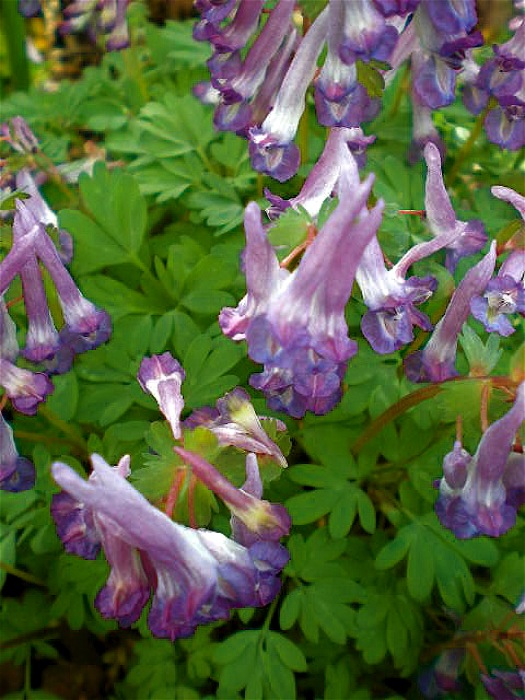
Corydalis cava March 2010

 Hacquetia epipactis March 2010

Here is a list of shade perennials for gardens in Seattle, the Pacific Northwest & USDA Zone 8.  They provide a range of color, height & texture. Bloom starts early in spring & lasts until summer.  But shade perennials are often prized for their beautiful foliage, instead of their flowers. You will need to keep snails & slugs from disfiguring the large leaves of some of these perennials. Gather them in a paper bag & toss it into the yard waste bin.  A perennial is any plant, not woody, that lives for at least a few years, although some are short-lived.  Perennials include bulbs, ferns & grasses.  Perennial groundcovers are listed in Groundcovers for Shade. Don't allow shade perennials to dry out completely in summer.  Some of these tolerate some dryness, as noted. But most prefer a moist environment.  If your garden is dry, read Dry Shade. Many of these perennials are common in gardens.  But it may take dedicated searching to find sources for all of them.  Although this list is not complete, it is fairly broad.  A single common name is noted when the plant has a common name.  While some have several common names, others have none at all.  Latin names will be most useful to you in finding uncommon plants.  An excellent reference book for perennials is Perennials: The Definite Reference With Over 2,500 Photographs by Roger Phillips & Martyn Rix.

Aconitum (Monkshood): many species
Actaea pachypoda (Doll's Eyes) Actaea rubra (Red Baneberry): berries highly poisonous
Adiantum pedatum (Maidenhair Fern)
Alchemilla mollis (Lady's Mantle): for part shade, tolerates dryness
Anemone x hybrida (Japanese Anemone): tolerates dryness, spreads widely by stolons, Anemone nemorosa (Wood Anemone) Anemone sylvestris (Wood Anemone): spreads widely by stolons
Aruncus aethusifolius, Aruncus dioicus, Aruncus 'Horatio' (Goatsbeard): tolerates some dryness
Athyrium niponicum ‘Pictum’ (Japanese Painted Fern)
Achlys triphylla (Vanilla Leaf): tolerates some dryness
Astilbe (Ostrich Plume): several species & cultivars
Bergenia (Elephant Ears)
Blechnum spicant (Deer Fern): tolerates some dryness
Cimicifuga (Bugbane)
Clintonia uniflora (Queen's Cup): & other species
Darmera peltata (Indian Rhubarb)
Dicentra cucullaria (Dutchman's Breeches) Dicentra eximia (Fringed Bleeding Heart) Dicentra spectabilis (Bleeding Heart, renamed Lamprocapnos spectabilis)
Diphylleia cymosa (Umbrella Leaf)
Digitalis purpurea (Foxglove): short-lived, but returns from seed
Doronicum (Leopard's Bane): several species for part shade
Dryopteris erythrosora (Autumn Fern): tolerates some dryness
Eomecon chionantha (Snow Poppy)
Epimedium (Bishop’s Hat): many species
Erythronium dens-canis (Dog-tooth Violet) Erythronium oregonum (Fawn Lily)
Gaultheria procumbens (Wintergreen)
Geranium 'Johnson's Blue' (Cranesbill) Geranium phaeum (Mourning Widow)
Glaucidium palmatum (Japanese Wood Poppy)
Hacquetia epipactis (Hacquetia): tolerates some dryness
Hakonechloa macra 'Aureola' (Japanese Forest Grass): & other cultivars
Helleborus argutifolius (Corsican Hellebore): part shade, Helleborus x hybridus (Lenten Rose) Helleborus lividus, Helleborus x sternii (H argutifolius x H lividus): all tolerate dryness
Hepatica americana (Liverwort)
Hosta (Plantain Lily): many species & cultivars
Jeffersonia diphylla (Twinleaf): tolerates some dryness
Kirengeshoma palmata (Yellow Wax Bells)
Ligularia (Leopard Plant): many species
Liriope muscari (Lily Turf): tolerates dryness
Luzula sylvatica (Wood Rush)
Lysichiton americanus (Skunk Cabbage): for wet places
Meconopsis betonicifolia (Blue Himalayan Poppy): & other species
Milium effusum 'Aureum' (Golden Wood Millet)
Petasites japonicus, Petasites palmatus (Coltsfoot): spreads widely by rhizomes
Polygonatum odoratum (Solomon’s Seal): & other species
Polystichum munitum (Western Sword Fern): tolerates dryness, Polystichum polyblepharum (Tassel Fern) Polystichum setiferum (Soft Shield Fern)
Primula (Primrose): many species & cultivars
Pulmonaria (Lungwort): many cultivars
Rodgersia podophylla (Rodgersia): & other species
Saruma henryi (Saruma)
Smilacina racemosa (False Solomon’s Seal): tolerates some dryness
Tellima grandiflora (Fringecup): tolerates some dryness
Thalictrum aquilegifolium (Meadow Rue): for light shade
Tiarella wherryi (Foam Flower)
Tolmiea menziesii (Piggyback Plant)
Tricyrtis (Toad Lily): several species & cultivars
Triosteum pinnatifidum (White Feverwort): tolerates some dryness
Trillium (Wake Robin, Toad Shade): many species
Uvularia grandiflora (Merry Bells)
Viola sempervirens (Pioneer Violet)