Friday, November 26, 2010

Wave Hill

 
Wave Hill November 2007

Wave Hill November 2007 Hudson River

Wave Hill November 2007 Trough Gardens

Wave Hill November 2007 Conservatory

 Wave Hill November 2007 Aquatic Garden

Wave Hill November 2007  Perennial Garden


Hudson River from Riverdale Station November 2007

I visited Wave Hill in the Bronx in New York City on November 11, 2007.  From my journal:  On Sunday it was cold & the sun shone brightly.  I spent over an hour at the Harlem Station while changing from the Harlem Line to the Hudson line.  I went a short way up the Hudson River to Riverdale.  The river was beautiful.  In Riverdale I visited Wave Hill.  It was lovely, but modest in scale.  The design was very good.  There were glimpses of the Hudson River between the colorful trees.  According to the New York Times, fall color was peaking, although it was not a particularly colorful fall.  At Wave Hill there was a water garden, a courtyard full of trough gardens, a conservatory & an alpine house, & several terraced gardens on the slope overlooking the river. 

Friday, November 19, 2010

New York Botanical Garden

New York Botanical Garden November 2007

New York Botanical Garden November 2007 Conservatory

New York Botanical Garden November 2007

New York Botanical Garden November 2007 Gift Shop & Cafeteria

New York Botanical Garden November 2007 Restrooms

I visited the New York Botanical Garden on November 8, 2007 with my friend & host.  It was cold & raining lightly.  We got off the Metro-North Harlem local line at Botanical Garden Station & walked a short distance to the Mosholu Gate entrance.  I was very impressed with the structures there. The buildings housing the cafeteria, gift shop & restrooms where beautifully clad in field stone.  It's seldom I take a picture of the restrooms.  The garden here was lovely in fall.  The massive conservatory was nearby.  It was an architectural marvel, but the planting design was poor.  (I'm spoiled by the Volunteer Park Conservatory in Seattle, where the planting design is impeccable.)  Just outside the Haupt Conservatory, there was a sheltered display of kiku, or Japanese Chrysanthemums.  There were also some fantastical woven bamboo art structures.     

Friday, November 12, 2010

The Dryland Garden

Echinocereus reichenbachii in Seattle June 2009

Yucca harrimaniae in Seattle August 2008

Sedum palmeri in Seattle December 2009

Tulipa turkestanica in Seattle March 2010

 Lewisia cotyledon in Seattle May 2010

Drylands are ecosystems with limited water, including scrublands, shrublands, grasslands, savannas, semi-deserts & true deserts.  A true desert garden is impossible in Seattle.  But you can give the impression of desert-like landscapes with carefully chosen plants, a very spare planting design, & plenty of rock & gravel.  This type of xeric garden is excellent for south or west-facing slopes, because it requires little or no irrigation.  If you’ve ever walked in a desert, you were probably surprised by the richness of the plant life.  There are some relatively barren deserts worldwide.  But the deserts of North America are filled with cactus, shrubs & small trees, perennial & annual wildflowers & grasses.  Below are images of natural drylands I have visited.  My ideas for the dryland garden are a synthesis of these landscapes & others I have seen.

 Joshua Tree National Park in California March 2009

Warm Springs Indian Reservation in Oregon September 1999

Frenchman Coulee in Washington June 2010

Cactus are nearly impossible to grow in Seattle.  I grow Echinocereus reichenbachii (Claret Cup Cactus) against the south side of a large stone, the only cactus that has worked for me.  Agave are somewhat less difficult.  I’ve tried at least a dozen, had success with Agave palmeri, Agave parryi var. huachucensis & Agave toumeyana var. bella. Yucca are similar to Agave & closely related.  Yucca filamentosa is widely grown in Seattle.  Native to the southeastern US, it tolerates dryness & moisture.  Western dryland Yucca that have grown well for me are Yucca harrimaniae, Yucca kanabensis, Yucca glauca, Yucca neomexicana & Yucca schottii.  I was amazed to find that Yucca whipplei, which grows in the very dry mountains near Los Angeles, grew to 4 feet  from a mere 6 inches in just 4 years.  It is both striking & alarming with its needle-tipped, sword-like leaves.  Plant Agave & Yucca well away from paths.  Agave, cactus & dryland Yucca should be grown in a raised area of gravelly & rocky soil.  Other successful succulent plants are Lewisia cotyledon & many Sedum.

I saw scrub oak growing in the Mojave Desert.  Scrub oaks include Quercus berberidifolia, Quercus john-tuckeri & Quercus vaccinifolia.  Shrubby pines such as Pinus edulis also grow in drylands.  A well-pruned Swiss Mountain Pine (Pinus mugo) will have a similar appearance.  Other dryland shrubs include manzanita & juniper.  You must to prune juniper, manzanita, oak & pine to give them a dryland appearance. To mimic sagebrush, use shrubs with gray foliage such as Brachyglottis munroi, Helichrysum splendidum & Santolina chamaecyparissus.  Rosa glauca & Rosa sericea var. pteracantha (with tall, thorny canes) give the impression of desert plants, especially in winter:

Wildflowers & grasses are always found in western drylands. Festuca idahoensis is a common grass from drylands of the Pacific Northwest & California.  It also grows west of the Cascade Mountains.  Try grasses with blue foliage such as Festuca ovina ‘Elijah Blue’ & Helictotrichon sempervirens, or with bronze foliage such as Carex comans ‘Bronze’ & Carex tenuiculmis ‘Cappucino’ .  For flowers use Achillea, Anthemis tinctoria, Erigeron, Penstemon x mexicali & Zauschneria californica.  Bulbs native to the western US are Calochortus & Triteleia.  Certain species tulips will also fit into this garden, although they are wildflowers from central Asian drylands.

Dry Garden Plant List
Succulents
Agave palmeri, Agave parryi var. huachucensis, Agave toumeyana var. bella
Echinocereus reichenbachii (Claret Cup Cactus)
Hesperaloe parviflora (Red Yucca)
Lewisia tweedyi, Lewisia cotyledon
Nolina nelsonii, Nolina parryi
Sedum divergens, Sedum oreganum, Sedum obtusatum, Sedum oregonense, Sedum palmeri, Sedum spathulifolium
Yucca filamentosa, Yucca harrimaniae (aka Yucca nana) Yucca kanabensis, Yucca neomexicana, Yucca glauca, Yucca schottii, Yucca whipplei

Shrubs & Small Trees
Arctostaphylos columbiana (Hairy Manzanita) Arctostaphylos bakeri, Arctostaphylos densiflora (Vine Hill Manzanita)
Brachyglottis monroi
Calluna vulgaris ‘Kerstin’, Calluna vulgaris ‘Silver Knight’
Eriogonum umbellatum (Sulfur Buckwheat)
Helichrysum italicumHelichrysum splendidum, Helichrysum tianshanicum
Juniperus californica, Juniperus squamata ‘Blue Star’, Juniperus squamata ‘Loderi’
Lithocarpus densiflorus var. echinoides (Dwarf Tanbark Oak)
Mahonia fremontii (Desert Holly) Mahonia pinnata
Penstemon pinifolius (Pineleaf Beardtongue)
Pinus aristata (Bristlecone Pine) Pinus edulis (Pinyon Pine) Pinus monophylla (Singleleaf Pinyon) Pinus mugo (Swiss Mountain Pine) Pinus quadrifolia (Parry Pinyon)
Quercus berberidifolia (Scrub Oak) Quercus gambelii (Gambel Oak) Quercus john-tuckeri (John Tucker Oak) Quercus vaccinifolia (Huckleberry Oak)
Rosa glauca, Rosa sericea var. pteracantha
Santolina chamaecyparissus (Lavender Cotton)

Perennials & Grasses
Achillea ageratifolia, Achillea clavennae, Achillea kellereri, Achillea serbica, Achillea tomentosa (Yarrow)
Anthemis tinctoria (Marguerite Daisy)
Briza media (Rattlesnake Grass)
Calochortus superbus, Calochortus venustus (Mariposa Lilies)
Carex comans ‘Bronze’ (New Zealand Sedge) Carex tenuiculmis ‘Cappuccino’
Coreopsis verticillata (Tickseed)
Deschampsia flexuosa (Crinkled Hairgrass)
Erigeron glaucus (Beach Aster) Erigeron karvinskianus (Santa Barbara Daisy) Erigeron lineraris (Desert Yellow Fleabane)
Eryngium variifolium (Moroccan Sea Holly) Eryngium yuccifolium (Rattlesnake Master)
Eschscholzia californica (California Poppy)
Festuca idahoensis, Festuca ovina ‘Elijah Blue’ (Fescues)
Helictotrichon sempervirens (Blue Oat Grass)
Pennisetum alopecuroides ‘Hameln’ (Fountain Grass)
Penstemon x mexicali (Beardtongue)
Triteleia laxa ‘Queen Fabiolia’ (aka Brodiaea ‘Queen Fabiola’)
Tulipa dasystemon, Tulipa saxatilis, Tulipa turkestanica (Species Tulips)
Zauschneria californica (California Fuchsia) Zauschneria latifolia

Groundcovers & Trailers
Arctostaphylos x media, Arctostaphylos nevadensis (Pinemat Manzanita) Arctostaphylos nummularia
Ceanothus griseus var. horizontalis (Carmel Creeper)
  
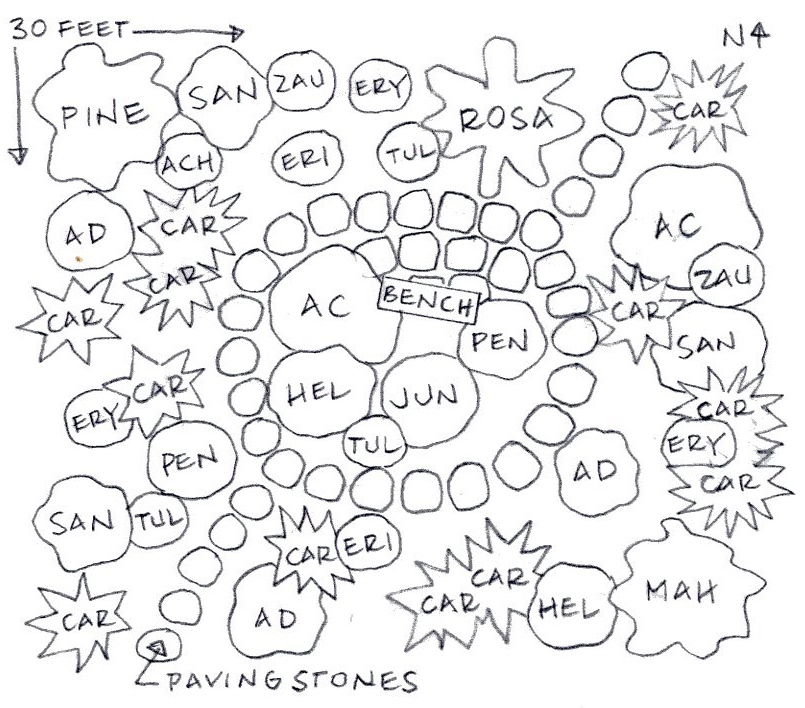
Plan for a Dryland Garden
This garden must be very well-drained.  It is best on south & west-facing slopes, in full sun.  The center area can be a raised bed enclosed with a stone wall.
Shrubs & Small Trees
AC = Arctostaphylos columbiana (Hairy Manzanita)
MAH = Mahonia fremontii (Desert Holly) or Mahonia pinnata
PINE = Pinus aristata (Bristlecone Pine) Pinus edulis (Pinyon Pine) Pinus monophylla (Singleleaf Pinyon) or Pinus quadrifolia (Parry Pinyon) or use Quercus berberidifolia (Scrub Oak) Quercus gambelii (Gambel Oak) Quercus john-tuckeri (John Tucker Oak) Quercus vaccinifolia (Huckleberry Oak)
SAN = Santolina chamaecyparissus (Lavender Cotton)

Perennials & Grass
ACH = Achillea tomentosa (Yarrow)
ERI = Erigeron glaucus (Beach Aster)
ERY = Eryngium variifolium (Moroccan Sea Holly) Eryngium yuccifolium (Rattlesnake Master)
ZAU = Zauschneria californica (California Fuchsia)

Groundcover

Mulch with crushed granite, gravel, lava rock, or other crushed rock.  Place smaller plants such as Achillea ageratifolia, Achillea clavennae, Achillea kellereri, Achillea serbica, Agave toumeyana var. bella, Cerastium tomentosum, Erigeron lineraris, Hirpicium armerioides, Lewisia tweedyi, Lewisia cotyledon, Sedum divergens, Sedum oreganum, Sedum obtusatum, Sedum oregonense, Sedum palmeri, Sedum spathulifolium, Yucca harrimaniae, Yucca nana &/or stones in open spaces as desired.  Agave & Yucca should be grown in a raised area of gravelly & rocky soil.

You can get Achillea ageratifolia, Achillea kellereri, Achillea serbica, Erigeron lineraris, Hirpicium armerioides, Mahonia fremontii, Pinus edulis, Yucca harrimaniae & Yucca nana by mail from High Country GardensPinus aristata, Quercus berberidifolia & Quercus gambelii are available from Forest Farm (other pines & oaks have been available in the past, may be in the future).

Friday, October 29, 2010

Warm Springs Indian Reservation

Juniperus occidentalis at Warm Springs Indian Reservation September 1999

Warm Springs Indian Reservation September 1999

Warm Springs Indian Reservation September 1999

 Juniperus occidentalis at Warm Springs Indian Reservation September 1999

Warm Springs Indian Reservation September 1999

The Warm Springs Indian Reservation covers more than 1,000 square miles in north central Oregon.  The western half of the reservation, on the eastern slopes of the Cascade Mountains, is forest.  The eastern half lies adjacent to the Oregon High Desert Region.  It shares typical high desert vegetation including Western Juniper (Juniperus occidentalis), sagebrush (Artemisia tridentata), Idaho Fescue (Festuca idahoensis), Oregon Sunshine (Eriophyllum lanatum), Sulfur Buckwheat (Eriogonum umbellatum) & Mariposa Lilies (Calochortus species).  On the eastern boundary, at the Deschutes River, annual precipitation is only about 10 inches with annual snowfall of around 15 inches.

In September 1999 I stayed in the dry side of the reservation at Kah-Nee-Ta Lodge.  In addition to fine accommodations, a pool & 2 restaurants, I greatly appreciated the opportunity to hike through the arid lands surrounding the lodge.  The weather was lovely.  The nearby Museum at Warm Springs made an excellent presentation of the traditions of the tribes that share the Warm Springs Indian Reservation: the Wasco, the Warm Springs & the Paiute.  The reservation was established in 1855 through a series treaties between the superintendent for the Oregon Territory (Joel Palmer), & representatives of the Warm Springs & Wasco tribes.  In 1879, the US government moved a small group of Northern Paiutes to the reservation.

 Jordan at Warm Springs Indian Reservation September 1999

Friday, October 22, 2010

Joshua Tree National Park

 Yucca brevifolia (Joshua Tree) in Joshua Tree National Park March 1999

Cylindropuntia bigelovii (Cholla Cactus) at Joshua Tree National Park March 1999

  Cylindropuntia bigelovii (Cholla Cactus) with bird's nest in Joshua Tree National Park March 1999

 Cylindropuntia bigelovii (Cholla Cactus) with grasses in Joshua Tree National Park March 1999

 Juniperus californica (California Juniper) in Joshua Tree National Park March 1999

 Pinus monophylla (Single Leaf Pinyon) in Joshua Tree National Park March 1999

 Joshua Tree National Park March 1999

Joshua Tree National Park is possibly the most intiguing & accessible landscape in California.  It lies not far from Palm Springs, about equidistant from Los Angeles & San Diego.  All 3 cities are common destinations for people from the Pacific Northwest during our rainy winter months, the best time time to visit the park. I have been to Joshua Tree National Park twice.  The 1st time was with my family in June 1971 when I was 12.  The place was then Joshua Tree National Monument.  It was hotter than I had ever imagined hot could be.  We stopped near an oasis ringed with palms (Washingtonia filifera).  The surface of the water was thick with bees.  Along the sweltering trail were grave markers of 19th century migrants who had attempted to cross the desert in wagons on their way to the coast.  I was quite sure they had died of the heat, if the bees hadn't killed them 1st.  I visited Joshua Tree National Park for the 2nd time in March 1999 with friends from Palm Springs.  The weather was perfect then.  I was amazed by the diversity of plant life in the desert, including scrub oak (Quercus john-tuckeri), pine (Pinus monophylla) & juniper (Juniperus californica), in addition to the ubiquitous Joshua Trees (Yucca brevifolia) & Cholla Cactus (Cylindropuntia bigelovii) I remembered from childhood.  The park covers almost 800,000 acres, including portions of both the Mojave Desert & the Colorado Desert.  

 Jordan at Joshua Tree National Park March 1999

Friday, October 15, 2010

The Mediterranean Garden at Kew Gardens

The Mediterranean Garden at Kew Gardens July 2009

Cistus in the Mediterranean Garden at Kew Gardens July 2009

Fremontodendron in the Mediterranean Garden at Kew Gardens July 2009

Genista in the Mediterranean Garden at Kew Gardens July 2009

Phlomis in the Mediterranean Garden at Kew Gardens July 2009

King William's Temple in the Mediterranean Garden at Kew Gardens July 2009

The Mediterranean Garden was definitely the high point of my visit to Royal Botanical Gardens, Kew in London in July of 2009.  It is truly a stunning garden.  The placement of the garden around, but mostly in front of King William's Temple, is superb.  The planting greatly enhances the structure.  It appears to be an abandoned edifice of ancient Rome in the midst of a Mediterranean wilderness.  The architecture of the portico is of the Tuscan Order, a simplified version of the Doric Order, columns with base, unfluted shaft & simply molded capital, plain entablature.  It was built in 1837.

The planting design is quite informal.  While there are many plants native to the Mediterranean Basin, contrary to the information at the Kew Gardens website, it does not 'depict a typical Mediterranean natural habitat.'  There are many plants here that are native to the Americas, including Fremontodendron californicum (California Flannel Bush) New World fan palms & Yucca.  But this mixture is common in Mediterranean gardens around the world.  Agave is often seen in Italian gardens.  For more information on Mediterranean plants, read The Mediterranean Garden

'Kew’s aim in creating the feature was to highlight the economic uses of many endemic Mediterranean plants, the diversity of life the habitat supports and the conservation efforts needed to ensure its survival. Stone pines (Pinus pinea) Tuscan olive trees (Olea europaea) and the green spires of Italian cypress (Cypress sempervirens) grow above shrubs such as Cistus and lavender (Lavandula lanata). Information boards explain the uses of some of the most economically important plants,' from the Kew Gardens website.

Friday, October 8, 2010

The Mediterranean Garden

Helleborus lividus April 2010 in the Cascadia Garden

Hypericum cerastoides May 2009 in the Cascadia Garden

Erica australis 'Holehird' February 2009 in the Cascadia Garden

Myrtus communis August 2010 at the Good Shepherd Center

Rosmarinus officinalis April 2010 in Seattle

Cupressus sempervirens March 2010 in Seattle

Sedum hispanicum September 2010 in the Cascadia Garden

The terms Mediterranean garden & Mediterranean plants can be somewhat confusing.  Many Mediterranean gardens include xeric plants from other regions of the world with Mediterranean climates.  Mediterranean gardens are sometimes defined by a formal, geometric style with generous use of stone, but usually with xeric plants.  Such gardens are also called Italian gardens, especially when they include many sculptures & few plants, believed by some to be the epitome of good taste. 

The Mediterranean climate is warm & dry, with winter rainfall & summer drought.  Such a climate exists in coastal regions of central Chile, central & southern California, southwestern Australia & the Western Cape Province of South Africa.  The plant communities in these places are known as maquis (or macchia) in Mediterranean Europe, matorral in Chile, chaparral in California, kwongan in Australia & fynbos in South Africa.

This Mediterranean garden is composed entirely of xeric plants native to the lands that border the Mediterranean Sea in Europe, Asia & Africa.  Plants that have a wide distribution beyond the Mediterranean Basin are excluded.  Design this garden in any way you like, exuberant or restrained, formal or informal.  Make this garden on ground that slopes to the south or west in Seattle.  It must be well-drained & exposed to maximum sun.  This garden will require little or no irrigation beyond the 1st summer.   

Mediterranean Garden Plant List
Trees
Arbutus unedo (Strawberry Tree)
Cedrus atlantica (Atlas Cedar) Cedrus libani (Cedar of Lebanon)
Cupressus sempervirens (Italian Cypress)
Laurus nobilis (Sweet Bay)
Pinus halepensis (Aleppo Pine) Pinus nigra (European Black Pine) Pinus pinaster (Maritime Pine) Pinus pinea (Italian Stone Pine)
Pyrus amygdaliformis (Almond Leaved Pear)
Querqus ilex (Holly Oak) Querqus suber (Cork Oak)

Shrubs
Cistus albidus (White Leaved Rockrose) Cistus clusii, Cistus crispus, Cistus incanus (Soft Hairy Rockrose) Cistus ladanifer (Gum Rockrose) Cistus monspeliensis (Montpelier Rockrose) Cistus salviifolius (Sage Leaved Rockrose)
Dorycnium hirsutum (Canary Clover)
Erica arborea (Tree Heath) Erica australis (Spanish Heath) Erica manipuliflora
Juniperus oxycedrus (Spanish Cedar) Juniperus phoenicea (Phoenicean Juniper)
Lavandula angustifolia (English Lavender, though not native there) Lavandula dentata (French Lavender) Lavandula stoechas (Spanish Lavender)
Myrtus communis (Common Myrtle)
Phlomis fruticosa (Jerusalem Sage) Phlomis italica: the epithet italica was given by Linnaeus as it had arrived from or via Italy, but the plant only grows in the Balearic islands. 

Perennials
Achillea tomentosa (Woolly Yarrow)
Allium moly (Golden Garlic) Allium neapolitanum (Naples Onion)
Antirrhinum 'Dulcinea's Heart', Antirrhinum majus (Common Snapdragon) Antirrhinum sempervirens, most species are perennial, of the 17 species, 16 are found in Spain.
Centranthus ruber (Jupiter's Beard)
Digitalis dubia (Dwarf Spanish Foxglove) Digitalis thapsii, Digitalis obscura (Sunset Foxglove)
Eryngium amethystinum (Amethyst Sea Holly) Eryngium bourgatii (Mediterranean Sea Holly) Eryngium variifolium (Moroccan Sea Holly)
Euphorbia characias (Mediterranean Spurge)
Galanthus ikariae (Green Snowdrop)
Helleborus argutifolius (Corsican Hellebore) Helleborus lividus (Majorcan Hellebore)
Helictotrichon sempervirens (Blue Oat Grass)
Iris filifolia, Iris lusitanica (Yellow Spanish Iris) Iris tingitana (Moroccan Iris) Iris xiphium (Spanish Iris) all closely related, these were used to create Dutch Iris.
Narcissus bulbocodium (Hoop Petticoats)
Paeonia clusii (Cretan White Peony) Paeonia corsica (aka P cambessedesii, Corsican Peony) Paeonia peregrina (Balkan Peony)
Scilla peruviana (Portuguese Squill) the scientific name peruviana results from confusion over the origin of the specimens from which the species was described by Linnaeus, who received specimens imported from Spain aboard a ship named Peru, & was misled into thinking the specimens had come from that country.
Salvia argentea (Silver Sage)
Stipa gigantea (Giant Feather Grass)

Groundcovers
Cerastium tomentosum (Snow in Summer)